
From Sketchbook to Showcase: How Designer Jewellery Comes to Life
By the time a piece of jewellery reaches a display case, it has already had a long life that nobody sees.
A sketch. A hundred small decisions. A craftsperson's hands shaping metal that did not exist in that form an hour earlier. Understanding this journey changes how you look at the piece you are about to buy.
Stage One: The Sketch
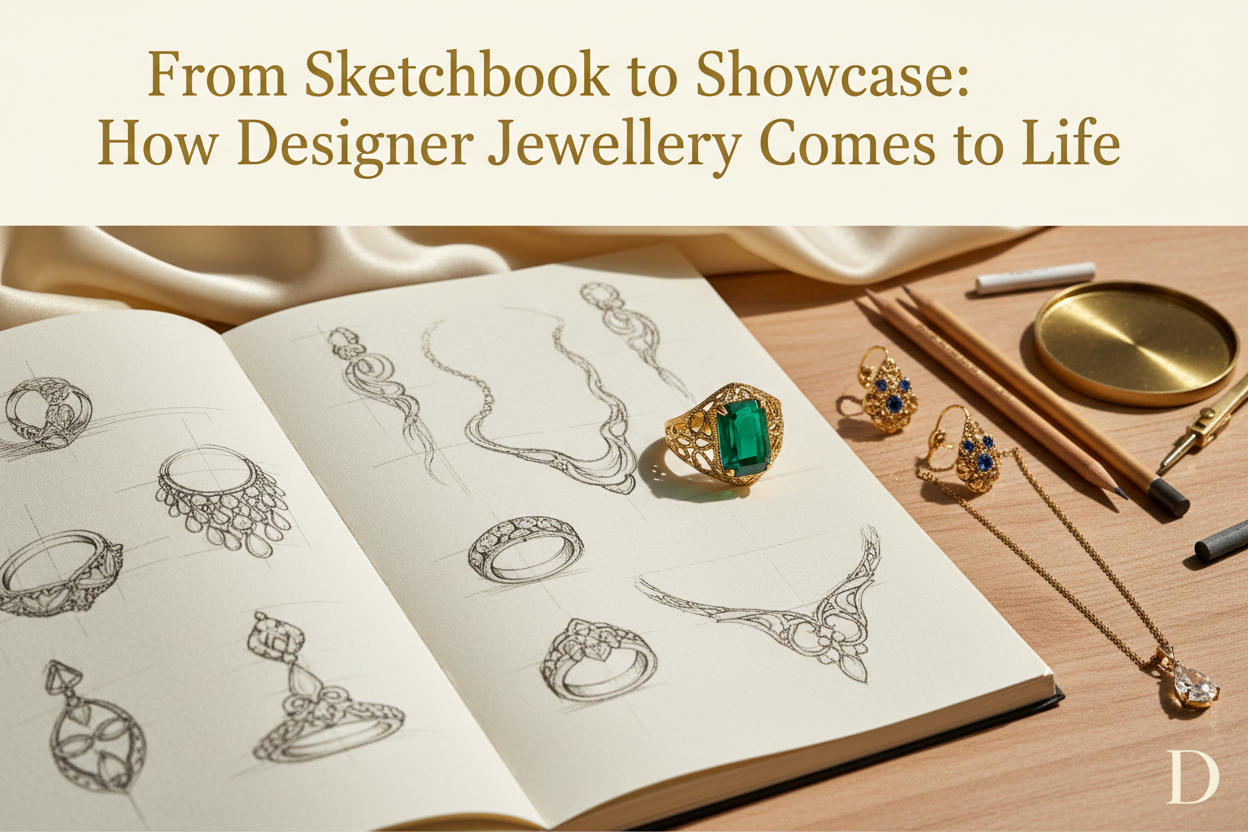
Every piece begins with an idea. Designers draw inspiration from client briefs, trends, nature, or personal vision. A jewellery designer skilled in the practical knowledge of materials, fabrication processes, and wearability creates extensive technical sketches before an item of jewellery is ever made. MineraliMinerali
Traditional hand-drawing and drafting techniques are still used in jewellery design, particularly during this conceptual stage, even as computer-aided design programs become more common. This early sketch is where proportion, scale, and wearability are decided long before any material is touched. Minerali
Stage Two: The Digital Model
A hand-drawn sketch captures an idea, but only a digital model can communicate exact measurements and structural details to a manufacturer. With CAD, a designer can mirror parts, copy and paste, and make sure parts are symmetrical down to a microscopic level. MineraliMinerali Store
Designers can adjust each piece's dimensions, curves, and settings with pinpoint accuracy, minimising the risk of errors when setting the stone. This stage is where a design becomes provably wearable, with the weight, thickness, and stone seats checked before a single gram of metal is cast. Minerali
Stage Three: The Hand Craft Tradition
Many of the most significant pieces at Minerali are not produced purely through CAD and casting. They are made the way they have been made in India for generations.
Karigars, as they are known in India, make an entire piece of jewellery by hand, from moulding the gold all the way to the jewellery's final finishing. Hand-fabricated jewellery reflects the skill of the karigar and gives them the freedom to make alterations based on the outcome of the design, and it commands a higher price because each piece takes much skill, with small differences between each one. MineraliMinerali
This is the tradition behind Kundan, Polki, and Meenakari work specifically. The metal block is rolled under heavy wheels to make sheets or wires, heated at constant intervals to increase its malleability, then moved to the karigar's table to form the base that will finally hold the gemstone. Minerali
Explore handcrafted pieces made through this traditional process:
Browse the Kundan jewellery collection at Minerali and the Sangeeta Boochra heritage silver collection, both rooted in generations of hand-fabrication skill.
Product Spotlight
The Jadau Kundan Bangle at Minerali is one of the clearest examples of the hand craft journey described above.
Every stone in a piece like this was individually set by a karigar working in 24 karat gold foil, without prongs or mechanical fixtures, using a technique passed down across generations rather than learned from a manual. The slight variations you can find if you look closely are not flaws. They are proof that a human hand made this, not a machine.
See the Jadau Kundan Bangle and look closely at the individually set stones that mark genuine hand craftsmanship.
Stage Four: Casting and Construction
For pieces that combine traditional and contemporary methods, the design completed digitally is transferred into manufacturing through lost wax casting, where the metal is poured into a mould shaped by the digital model. The wax is melted away and the chosen metal, usually gold or silver, is substituted in molten form, hardening into the final shape of the piece. MineraliMinerali
A jeweller then refines the main construction, filing down the surface to uncover the metal beneath the casting skin, and makes any necessary aesthetic alterations to ensure the piece can functionally support its gemstones. Minerali
Stage Five: Stone Setting
This is the most delicate stage in the entire journey. The diamond setter places the centre stone into the mount with care, and if side stones are used, each one is set individually under a microscope. Minerali
For Kundan and Polki pieces specifically, this stage is entirely manual. The karigar presses softened gold foil around each individual stone, judging by feel and eye whether the setting is secure, with no two pieces ever set in exactly the same way.
Product Spotlight
The Festive Meenakari Choker Necklace at Minerali shows what happens when stone setting is followed by an entirely separate craft discipline.
After the front of the piece is completed, the reverse is finished with Meenakari enamel work, a craft requiring its own years of training in temperature control and colour application. This is why a single Kundan or Meenakari piece often passes through more than one specialist artisan before it is finished.
Explore the Festive Meenakari Choker Necklace and notice the enamel reverse, the work of a second craft specialist entirely.
Stage Six: Polishing and Final Inspection
A polisher works to ensure the metal is perfectly polished and as gleaming as possible in the final stage. Any last touches, such as engravings, are applied as well, and finally the jewellery is examined in detail to ensure production has gone smoothly. Minerali
Pieces are also placed in an ultrasonic cleaning machine to remove any residue from manufacturing that cannot be reached by hand polishing alone. Minerali
Only after this final inspection does a piece leave the workshop and reach a showcase.
Why This Journey Matters to You as a Buyer
Knowing this process gives you a genuine way to evaluate quality. Look at the symmetry of a piece, the security of the stone settings, the finish on the reverse, and the smoothness of any moving parts like clasps and earring hooks. These are the visible results of every stage above, done well or done quickly.
Frequently Asked Questions
Does all designer jewellery start with a hand sketch?
Most designs begin as a sketch or a concept, even when the production process later moves into digital modelling and casting. A hand-drawn sketch captures the original idea before structural details are finalised digitally. Minerali
What is the difference between cast jewellery and hand-fabricated jewellery?
Hand-fabricated jewellery is shaped entirely by a karigar's hands from raw metal, while cast jewellery is formed by pouring molten metal into a mould shaped from a digital or wax model. Hand fabrication typically commands a higher price due to the skill and individual variation involved. Minerali
How long does it take to make a piece of designer jewellery?
This varies enormously by complexity. A simple cast piece can take days, while a complex hand-set Kundan or Polki piece can take weeks of skilled artisan work.
Why do Kundan and Polki pieces have enamel on the back?
The reverse is traditionally finished with Meenakari enamel as a mark of complete craftsmanship, reflecting the belief that a piece worn close to the body deserves beauty on both sides.
What should I look for to judge the quality of a finished piece?
Even stone placement, a smooth and finished reverse, secure clasps and earring hooks, and consistent polish across the entire surface.
Final Thoughts
Every piece you see on Minerali carried this full journey before it reached you, a sketch, a structural plan, the hands of one or more skilled artisans, and a final inspection that decided whether it was good enough to leave the workshop.
Browse the full collection at mineralistore.com and choose a piece knowing exactly what went into making it.

How to Build a Minimalist Jewellery Capsule Collection...
Sep 04, 2026

Jewellery Care Tips for Different Materials: Polki, Kundan,...
Aug 28, 2026

How Our New Arrival Collections Are Curated by...
Aug 24, 2026

How Jewellery Designers Turn Indian Heritage into Modern...
Aug 21, 2026

The Ultimate First-Time Jewellery Buyer's Guide: Everything You...
Aug 21, 2026

How to Start a Heritage Jewellery Collection Without...
Aug 14, 2026

How to Build Separate Jewellery Looks for Your...
Aug 10, 2026

How to Style Jewellery for Daytime vs Evening...
Aug 07, 2026

Can Minimalist Jewellery Work with Ethnic Wear? Styling...
Aug 03, 2026

Jewellery Gifting Guide: How to Choose the Perfect...
Jul 29, 2026

