
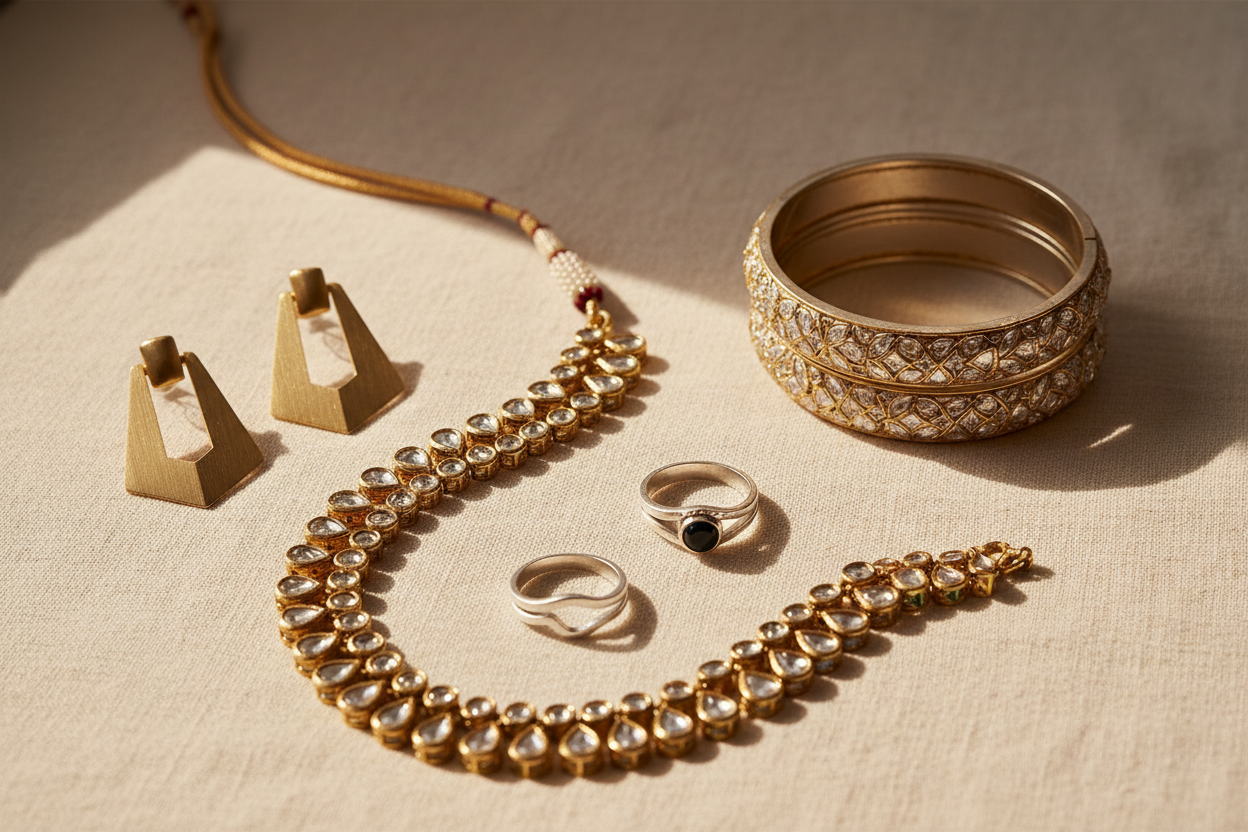
How to Mix and Match Jewellery Without Overdoing It
Most people own more jewellery than they wear well.
Not because they have bad taste. Because nobody ever taught them the difference between wearing jewellery and styling jewellery.
Wearing jewellery is putting pieces on. Styling jewellery is making conscious choices about which pieces go together, which one leads, and which ones stay in the drawer for this particular look.
The difference between someone who looks perfectly put together and someone who looks overdressed is almost always in how they made those choices. The overdressed person put on everything they liked. The put-together person chose one piece they loved and built carefully around it.
This guide teaches the principles that make mixing and matching jewellery work. Not rules you have to follow blindly. Principles you understand deeply enough to apply with your own eye.
The One Principle That Covers Everything
Before the specifics, here is the single most important idea in jewellery styling.
Every look needs one lead piece and everything else plays a supporting role.
The lead piece is the piece that draws the eye first. It is the piece that makes the impression. Everything else on your body, the rest of your jewellery, the outfit, even the makeup, is chosen to support that piece rather than compete with it.
This is why some people look magnificent wearing very little jewellery and others look cluttered wearing beautiful pieces. The person who looks magnificent chose their lead piece and let it breathe. The person who looks cluttered has four things competing to be the lead and none of them winning.
Find your lead. Build around it. That is the whole game.
Rule 1: Choose One Zone to Focus On
Your body has three main jewellery zones. The face and ears. The neck and collarbone. The wrists and hands.
The most balanced looks focus on one zone at a time.
If you are leading with earrings, keep the neck clean or minimal. If you are leading with a necklace, wear simple studs or no earrings at all. If your wrists are the story, keep both the ears and the neck quieter.
This does not mean you cannot wear pieces in multiple zones. It means one zone has the lead piece and the other zones have supporting pieces, which are smaller, simpler, and quieter by comparison.
The mistake most people make is putting statement-level pieces in multiple zones simultaneously. Two statement things in one look do not double the impact. They halve it, because neither one gets to be the statement.
Build around a lead piece from Minerali's collections: Browse the danglers and statement earrings collection at Minerali to find lead earring pieces, then choose your supporting necklace and wrist pieces accordingly.
Rule 2: Mix Metals on Purpose, Not by Accident
The old rule that you should never mix gold and silver jewellery is finished. Mixing metals is not only acceptable, it is one of the stronger styling moves in contemporary Indian jewellery.
But there is a difference between mixing metals intentionally and mixing them by accident.
Gold, silver, and rose gold can coexist beautifully if done thoughtfully. Begin with a bridge piece like a bangle that features multiple tones to tie your look together. Once you have figured out the style, you can layer silver rings with gold chains for a modern, intentional finish.
Intentional metal mixing has a dominant metal and an accent metal. If your necklace and earrings are gold, your bracelet can be silver. The gold dominates. The silver accents. The look reads as deliberate because there is a clear hierarchy.
Accidental metal mixing has no hierarchy. Three random pieces in three different metal tones without any visual relationship between them. This is what looks scattered.
The test: if you look at your jewellery combination and cannot identify which metal is dominant, you are mixing by accident rather than by intention. Fix it by removing the piece that is most at odds with the dominant tone.
Find pieces in consistent metal families at Minerali: Browse gold-finish contemporary necklaces and 925 sterling silver contemporary pieces at Minerali to build intentional metal combinations with clear hierarchy.
Rule 3: Match the Weight of Your Jewellery to Your Outfit
This is the rule most styling guides mention but very few explain properly.
Heavy jewellery, meaning large, embellished, or complex pieces, works with outfits that have weight and substance. Rich fabrics, embroidered surfaces, heavy silk, velvet. The jewellery and the outfit are matched in visual weight and they hold each other.
Light jewellery, meaning small, delicate, or minimal pieces, works with outfits that are similarly light. Cotton, linen, chiffon, plain fabrics. The jewellery complements the simplicity of the outfit rather than overwhelming it.
The problem happens when heavy jewellery meets a light outfit, or light jewellery meets a heavy outfit. Heavy jewellery on a light cotton dress looks like you got dressed for the wrong occasion. Light jewellery on a heavily embroidered lehenga looks like the jewellery forgot to show up.
Match the weight. Heavy to heavy. Light to light.
The one exception: intentional contrast. A single bold piece worn against a plain simple outfit works as a deliberate contrast statement. But only one bold piece. Not a full heavy set against a simple dress.
Product Spotlight
The Boho Charm Treasure Chain at Minerali is a piece that demonstrates exactly how a lighter, more playful piece works in a mix.
This chain has enough personality to be a supporting character in a look with a stronger lead piece, or it can be the casual lead piece in a simpler, lighter combination. Its character is present without being demanding. In a mix, it adds texture and interest without competing with stronger pieces. That balance between presence and restraint is what makes a piece genuinely versatile for mixing.
See the Boho Charm Treasure Chain and consider where it fits in your current jewellery combinations as either a lead or a supporting character.
Rule 4: Vary Texture Before You Vary Size
When mixing multiple pieces in one look, most people vary the size and end up with a confusing mix of big and small things at random scales.
A more effective approach is to vary texture while keeping proportions more consistent.
A smooth Kundan necklace with a textured silver cuff. A polished gold hoop with a matte-finish bangle. A bright stone pendant with a hammered metal ring. These combinations create visual interest through contrast of surface quality rather than contrast of scale.
Varying texture feels considered. Varying size randomly can feel accidental.
When you do mix scales, be intentional about the relationship. A large statement earring pairs with a very small stud on the other ear for an asymmetric look. A bold necklace pairs with tiny stud earrings that are nearly invisible. The contrast in scale is the point and it is deliberate, not accidental.
Mix textures with pieces from across Minerali's collections: Browse Kundan stone-set pieces alongside 925 silver handcrafted jewellery by Sangeeta Boochra at Minerali for texture-based mixing options with genuine craft behind each piece.
Rule 5: Build a Colour Thread Between Your Pieces
When you mix jewellery from different collections or different aesthetics, the mix can easily look random rather than curated.
One way to unify a mix visually is through a shared colour element. If your necklace has green stones, repeat green somewhere else in the look, whether in a ring stone, in a single bangle, or in the outfit itself. The repeated colour creates a visual thread that makes the look feel assembled rather than coincidental.
This does not mean matching. Two different shades of green in different pieces creates a colour family. Two identical pieces in the same green is matching, which is different and less interesting.
The colour thread works particularly well in festive dressing where multiple pieces are worn at once. A Kundan necklace with red stones, a single red stone ring, and red accents in the bangles creates a cohesive colour story across three separate pieces without the pieces being a set.
Rule 6: The Rule of Odd Numbers
Odd numbers of pieces tend to look more natural and less formal than even numbers.
Three pieces of jewellery look more effortless than four. Five pieces look more curated than six. This is because even numbers suggest deliberate symmetry, which reads as formal and structured. Odd numbers suggest a more organic, personal approach to getting dressed.
In practice: if you are wearing earrings, a necklace, and a bracelet, that is three pieces and it works. Adding a ring makes it four, which reads more formally. Adding a second ring makes five, which works again. This is a subtle principle but it is worth noticing in looks that feel slightly off without you knowing why.
Rule 7: Edit Before You Leave the House
The most important mixing and matching advice is also the simplest. Once you have your full combination on, remove one piece.
Almost every time, the look is better after the removal.
This is because when you put pieces on one at a time, each one looks right in isolation. It is only when you see the full combination in a mirror that you can judge whether everything is working together or fighting each other. And almost always, one piece is fighting.
The piece to remove is usually the one you put on last. It is usually the extra one, the piece added because you thought the look needed something more. It usually needed something less.
Give your look a lead with one statement jewellery piece and then let it shine. Keep the surrounding pieces understood so they complement rather than complete the look.
Find the right lead pieces to build a curated mix around: Browse the exclusive Prerto designer collection and Bijoux by Priya Chandna jewellery at Minerali for statement lead pieces with strong enough design identity to anchor a mix without needing many supporting pieces.
Product Spotlight
The Shakti Necklace at Minerali is exactly the kind of lead piece the editing rule is designed for.
A necklace with this kind of presence needs almost nothing alongside it. Minimal studs or no earrings. One slim bangle or no wrist jewellery at all. The necklace makes the statement. Everything else is in service to it. This is what a strong lead piece looks like in practice.
Explore the Shakti Necklace and use it as a reference point for understanding what a piece looks like when it genuinely commands the lead role.
How to Mix Indian and Contemporary Jewellery Together
One of the most common mixing challenges for Indian women is combining traditional Indian jewellery with more contemporary or western pieces.
The formula that works is one from each world, not two from each.
One Kundan earring with a contemporary silver cuff. A traditional jhumka with a thin modern chain necklace. An oxidised silver piece with a clean contemporary ring. The contrast between the two worlds creates the interest. Multiple pieces from both worlds simultaneously creates visual noise.
The other key is scale. The Indian piece should typically be the lead, because Indian jewellery tends to be bolder and more visually complex. The contemporary piece supports it with restraint.
A jhumka and a simple silver bracelet is an Indo-fusion look that works. A jhumka and a bold statement necklace and a chunky cuff is three things competing in two cultural registers and none of them winning.
Frequently Asked Questions
How many pieces of jewellery should you wear at once?
Two to four pieces is the most versatile range for everyday and office wear. For festive occasions, four to six works well. For weddings as a guest, five to seven is appropriate. The number is less important than the principle that one piece leads and the rest support it.
Can you mix gold and silver jewellery together?
Yes. Mixing metals is one of the strongest current styling moves in Indian jewellery. The key is to have a dominant metal and an accent metal. One of the two should lead in the majority of your pieces. The other appears as a supporting accent. If you cannot identify a dominant metal in your combination, the mix is accidental rather than intentional.
How do you know if you are wearing too much jewellery?
If you look in the mirror and cannot immediately identify which piece is the lead, you are wearing too much. If you feel weighted down or uncomfortable, you are wearing too much. If you put the look together and felt the urge to add one more thing, take one thing off instead.
Can you mix traditional Indian jewellery with western pieces?
Yes, and this is one of the strongest Indo-fusion styling moves. One piece from each world is the formula that works. A traditional Kundan earring with a contemporary silver cuff. A jhumka with a thin contemporary chain. The contrast between the two aesthetics creates the visual interest. Multiple pieces from both simultaneously creates noise.
What is the easiest way to start mixing jewellery if you are not confident?
Start with three pieces. One earring, one necklace, one wrist piece. Make sure one of the three is clearly the strongest piece visually. That is your lead. The other two should be noticeably quieter. Build from there once you are comfortable with the three-piece framework.
Quick Mixing Reference Guide
Lead with earrings: Keep necklace minimal or skip it. One slim bracelet or cuff at the wrist. One ring.
Lead with necklace: Wear minimal studs or no earrings. One thin bangle or simple bracelet.
Lead with a cuff or bangle: Keep earrings small. Keep necklace short and simple.
Mixing metals: Gold dominant with silver accent, or silver dominant with gold accent. Never three different metals equally.
Mixing Indian and contemporary: One from each world. Indian piece leads. Contemporary piece supports.
Edit rule: Always remove one piece before you leave the house.
Final Thoughts
Mixing and matching jewellery is a skill. And like any skill it gets easier the more you practice it deliberately.
The principles are simple: one lead piece, matched weight, varied texture, colour thread, odd numbers, edit ruthlessly. Apply them consistently and the difference in how your jewellery looks and feels will be immediate.
Minerali carries designer jewellery across contemporary, Kundan, Polki, and silver collections with enough range and variety to build intelligent mixes across aesthetics, occasions, and moods.

Written by Chirag Jain

How to Build a Minimalist Jewellery Capsule Collection...
Sep 04, 2026

Jewellery Care Tips for Different Materials: Polki, Kundan,...
Aug 28, 2026

How Our New Arrival Collections Are Curated by...
Aug 24, 2026

How Jewellery Designers Turn Indian Heritage into Modern...
Aug 21, 2026

The Ultimate First-Time Jewellery Buyer's Guide: Everything You...
Aug 21, 2026

How to Start a Heritage Jewellery Collection Without...
Aug 14, 2026

How to Build Separate Jewellery Looks for Your...
Aug 10, 2026

How to Style Jewellery for Daytime vs Evening...
Aug 07, 2026

Can Minimalist Jewellery Work with Ethnic Wear? Styling...
Aug 03, 2026

Jewellery Gifting Guide: How to Choose the Perfect...
Jul 29, 2026

