
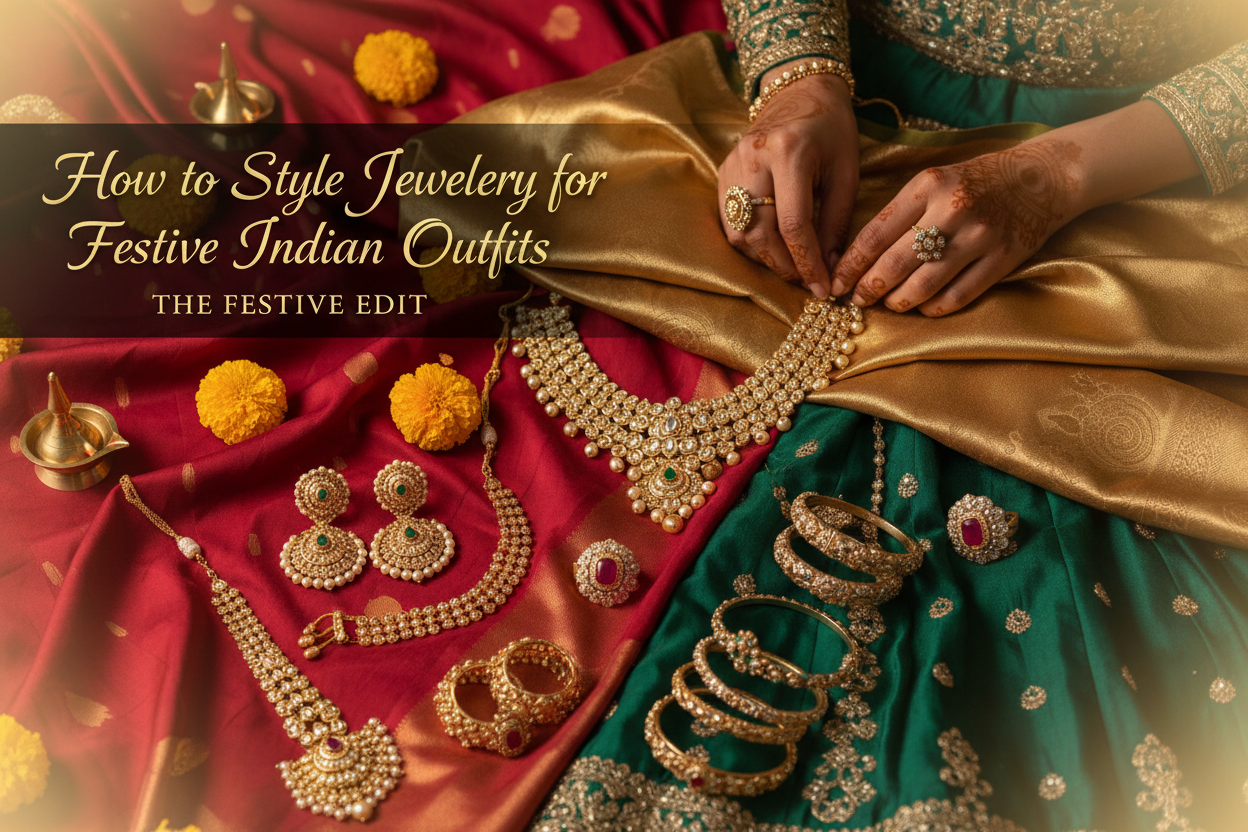
How to Style Jewellery for Festive Indian Outfits
Festive dressing in India is some of the most considered dressing in the world.
Every outfit has layers. Every layer has embellishment. Every embellishment has a specific cultural context. And every look you put together for Diwali, Navratri, Eid, or a family wedding carries a level of visibility and scrutiny that casual western dressing never does.
In that context, jewellery is not the finishing touch. It is a structural decision.
The right jewellery makes a festive outfit look complete. The wrong jewellery can undermine even the most beautiful outfit. And wearing the right pieces in the wrong combinations, too many, too few, too heavy, too light, too matched, too mismatched, is just as damaging as the wrong piece entirely.
This guide covers exactly how to style jewellery for every major festive Indian outfit type. It goes outfit by outfit, neckline by neckline, occasion by occasion. It tells you what works and why. It tells you what to avoid and what the mistake looks like when you make it. And it links to specific designer pieces at Minerali that belong in each look.
The One Principle That Governs All Festive Jewellery Styling
Before the outfit-specific guidance, one principle covers everything.
Match the weight of your jewellery to the weight of your outfit. For heavy embroidery, opt for simpler jewellery to maintain balance and elegance. For a minimal saree look, choose simple stud earrings and a delicate bracelet.
This is the single most important principle in festive jewellery styling and the one most consistently broken.
Heavy embroidered outfit plus heavy jewellery set equals visual chaos. Neither the outfit nor the jewellery gets to breathe. The eye has nowhere to rest and the overall impression is overdressed rather than festive.
Minimal or plain outfit plus heavy jewellery equals the jewellery being the story. This is a powerful festive look when done intentionally.
Heavy outfit plus restrained jewellery equals the outfit being the story. This is an equally valid and often more elegant festive look.
The mistake is always trying to do both simultaneously. Let one lead. The other supports.
Styling Jewellery for the Saree
The saree is the most versatile festive outfit in India for jewellery because the range of fabrics, occasions, and aesthetics it covers is enormous. A cotton saree at a Diwali puja and a Kanjivaram silk at a wedding reception are both sarees. They need completely different jewellery.
Silk and Heavy Fabric Sarees
Silk sarees, Banarasi sarees, Kanjivaram, and brocade all belong to the heavy fabric category. They have substantial visual weight and rich surface texture.
For silk sarees, opt for heavy gold or Polki jewellery. The weight and richness of the fabric calls for jewellery that matches it in visual substance.
The necklace choice for a silk saree should sit confidently. A Kundan choker or a short Kundan necklace set for a round or square neckline blouse. A longer Polki pendant or layered necklace for a V-neck or sweetheart blouse. A bold chandbali or jhumka when the blouse has a high neck or an embellished neckline that makes a necklace unnecessary.
Match jewellery tones with saree borders or blouse details for a cohesive look. If your Banarasi saree has a gold zari border, your jewellery should also be gold-toned. If your Kanjivaram has a contrasting border, use the border colour as your stone colour cue.
What to avoid: mixing gold and silver tones with a traditional silk saree. The warmth of the silk and the gold zari work demands one consistent metal family.
Find Kundan and Polki pieces for heavy silk saree styling: Browse the Kundan jewellery collection for festive silk saree looks and the Polki collection for heritage-quality necklace and earring options at Minerali.
Product Spotlight
The Kundan Blossom Glow Necklace Set is one of the strongest choices for a heavy silk saree at Minerali.
The layered structure of this necklace matches the richness of a Banarasi or Kanjivaram saree. The floral Kundan motifs echo the natural beauty of traditional silk weaving patterns without duplicating them. The gold-finish setting sits naturally with zari borders and embroidered blouses. And the set format means the earrings are already chosen, which removes one decision from the festive morning rush.
Pair this with your most embellished silk saree, minimal bangles, and a maang tikka if your hairstyle supports it.
Explore the Kundan Blossom Glow Necklace Set and see how layered Kundan craftsmanship creates the right visual weight for a heavy silk saree look.
Chiffon, Georgette, and Lightweight Festive Sarees
Lighter fabrics like chiffon pair well with delicate pieces. Match the jewellery style to the saree's elegance.
A chiffon or georgette saree has movement and softness. Heavy Kundan sets weigh down the aesthetic and create a jarring contrast between the delicate fabric and the substantial jewellery.
Chandbalis work well with lightweight festive sarees. A pair of chandbalis or lightweight danglers with a chiffon saree is one of the cleanest festive looks available. The earrings move with the fabric. They add presence without heaviness. And they allow the drape and flow of the chiffon to remain the visual lead.
For necklaces with chiffon sarees, choose shorter pieces with fine settings. A delicate pendant. A thin layered chain. A contemporary necklace in a light gold-finish setting. Not a full Kundan set.
What to avoid: heavy stone-set necklaces with chiffon or georgette sarees. The fabric cannot hold its own against the jewellery weight, visually or physically.
Browse lightweight earrings and necklaces for chiffon saree styling: Explore chandbalis for lightweight festive saree looks and contemporary necklaces for delicate festive styling at Minerali.
Cotton and Handloom Sarees
Cotton and handloom sarees have a completely different festive context. They are more casual, more personal, and more culturally rooted in everyday Indian life than silk or chiffon festive wear.
Oxidised jewellery works well with cotton kurtas, handloom sarees, and boho-inspired festive looks.
For cotton sarees, the jewellery should feel equally grounded. Silver pieces with texture, oxidised silver, contemporary stone-set designs, and natural material accents all work better with handloom cotton than polished gold-finish Kundan.
Pairing a sleek monochrome saree dress with a centuries-old silver filigree necklace creates a striking fusion. The saree's clean lines highlight the jewellery's detailed craftsmanship, and the contrast makes both stand out.
This is one of the strongest styling moves for a cotton or handloom saree: one heritage silver piece worn against the clean simplicity of a handwoven textile. The craft in both is visible. The contrast between the two creates genuine visual interest.
Find silver jewellery for cotton and handloom saree styling: Browse 925 silver earrings and necklaces by Sangeeta Boochra for handcrafted heritage silver pieces that pair naturally with cotton and handloom sarees.
Styling Jewellery for the Lehenga
Lehengas are statement outfits, so jewellery should complement rather than overpower.
This is the most important lehenga jewellery principle and the one most consistently ignored. A heavily embroidered, deeply coloured lehenga is already doing significant visual work. Adding a full Kundan set on top of it does not double the impact. It creates visual competition where neither the outfit nor the jewellery wins.
Heavily Embroidered Lehengas
When you wear a heavily embroidered lehenga or saree, first pick one main item to wear. A bold necklace, oversized earrings, or a Maang Tikka. Choose one and let it lead.
The anchor piece for a heavily embroidered lehenga should be chosen based on the neckline of the blouse.
A deeply embellished neckline or a heavily worked blouse: skip the necklace entirely. Let the blouse be the neckline story. Choose a bold earring instead, a large chandbali or a pair of Polki jhumkas, and let the earrings frame the face above the embellished blouse.
A plain or minimal blouse with a heavy lehenga skirt: this is where a Kundan choker or a layered necklace set earns its place. The plain blouse gives the necklace a clean surface to work against.
Women with elaborate blouses or neckline designs should select statement earrings instead of big necklaces.
What to avoid: a full necklace set plus statement earrings plus a maang tikka plus a haath phool plus stacked bangles with a heavily embroidered lehenga. This is the most common festive overdressing mistake. Choose two to three pieces maximum. Let the lehenga do the rest.
Find the right earrings for heavily embroidered lehenga looks: Browse jhumkas for lehenga earring styling and chandbalis for bold festive earring options at Minerali.
Product Spotlight
The Navratan Polki Choker With Center Pendant at Minerali is one of the most effective necklace choices for a heavily embroidered lehenga with a plain or minimal blouse.
The Navratan stone combination creates immediate visual richness without requiring additional pieces to feel complete. The choker form sits at the collarbone and creates a clean boundary between the plain blouse and the heavily worked lehenga. The Polki diamonds give the piece a heritage seriousness that matches the significance of a lehenga occasion. And the pendant center creates a focal point that draws the eye upward to the face rather than down into the embroidery.
See the Navratan Polki Choker With Center Pendant as the anchor necklace piece for a lehenga with a plain blouse and heavy skirt embroidery.
Pastel and Lighter Lehengas
Pastel lehengas have been one of the strongest festive and bridal fashion trends in India for the past two years and they carry completely different jewellery requirements from deep-toned lehengas.
Pastel Polki jewellery with soft-coloured stones, mint, blush, lavender, pairs exceptionally well with pastel outfits and monochrome looks.
For ivory, blush, mint, and powder blue lehengas, the jewellery should match the softness of the palette rather than create contrast against it. A Kundan piece with pale stone accents. A pearl-forward necklace. A Polki set with softer stone colours. A diamond-finish contemporary piece that adds sparkle without adding colour warmth.
What to avoid: deep red or vivid green stone Kundan sets with pastel lehengas. The colour contrast is too sharp and disrupts the intentional softness of the look.
Find jewellery for pastel lehenga styling: Explore the diamond jewellery collection at Minerali for pieces that add sparkle and presence to a pastel lehenga without disrupting its colour palette.
Styling Jewellery for the Anarkali
The Anarkali is one of the most forgiving festive outfits for jewellery because its high waist and flared skirt create a clean, vertical canvas that works with a wide range of jewellery choices.
The key variable with an Anarkali is the neckline. Most Anarkalis have either a round neck, a V-neck, or a boat neck, each of which calls for a different necklace approach.
Round neck Anarkali: a choker or a short necklace that sits at the collarbone. A Kundan choker with a round neck Anarkali is one of the most consistently photographed festive looks.
V-neck Anarkali: follow the V-line with a longer pendant or a layered necklace. The pendant should sit within the V rather than below it.
Boat neck or wide neckline Anarkali: either a very short choker that sits above the boat neck, or no necklace at all. Bold chandbalis or jhumkas are the stronger choice with a boat neck because the wide horizontal neckline competes with a necklace.
Statement earcuffs. A single earcuff replacing a full earring is a modern, editorial choice that works well with high necklines and structured blouses.
For contemporary Anarkali cuts with structured high necklines, a single ear cuff or ear chain is an increasingly strong festive styling choice. It is modern, personal, and does exactly what a statement earring does in terms of framing the face without the traditional form of a jhumka or chandbali.
Browse jewellery options for Anarkali necklines: Explore ear chains for modern Anarkali styling and ear cuffs for contemporary festive looks at Minerali alongside the Kundan choker range for classic Anarkali pairings.
Product Spotlight
The Festive Meenakari Choker Necklace at Minerali is one of the most precise pairings for a plain or lightly embroidered Anarkali.
The Meenakari enamel colour work on this choker does what a heavily embroidered Anarkali cannot. It adds rich traditional colour in a controlled, wearable form. Worn with a plain or simply embroidered Anarkali, this choker creates the festive richness that the outfit needs without competing with any existing surface decoration. The choker form sits correctly with round and V-neck Anarkalis. The vivid enamel photographs beautifully under festive lighting.
Explore the Festive Meenakari Choker Necklace and see how Meenakari enamel craftsmanship creates the right festive impact for a round-neck or V-neck Anarkali.
Styling Jewellery for Kurta Sets and Salwar Kameez
Kurta sets and salwar kameez cover the widest range of festive occasions, from a casual Diwali puja to a more dressed-up family gathering. The jewellery approach depends almost entirely on how embellished the kurta itself is.
Heavily Embellished Kurta or Suit
For a festive kurta set, try one statement piece that draws the eye. Let the outfit do most of the work.
A heavily embroidered or heavily embellished kurta needs minimal jewellery. One pair of earrings. Either studs or small jhumkas. No necklace or a very simple chain. Two to three slim bangles. One ring. Done.
The embellishment on the kurta is already telling a story. Additional jewellery competes with that story rather than completing it.
Plain or Printed Kurta
A plain or printed kurta is a canvas for jewellery in a way that a heavily embellished one is not. Here, the jewellery can lead.
A statement necklace with a plain kurta. A pair of bold jhumkas with a printed suit. A contemporary Kundan pendant with a simple geometric print. The outfit provides the background. The jewellery provides the interest.
Layered necklaces enhance plain or monochrome outfits. For a plain festive kurta, a layered necklace or a Kundan choker with a slightly longer chain creates depth and visual movement at the neckline that a single chain cannot.
What to avoid: wearing your most minimal jewellery with a plain kurta at a festive occasion and then wondering why the look feels unfinished. A plain festive kurta specifically needs the jewellery to carry some of the occasion's visual weight.
Find necklaces for plain and printed kurta styling: Browse necklaces at Minerali for festive kurta sets and danglers for printed kurta earring pairings to find pieces that carry the visual weight of a plain festive kurta.
Styling Jewellery for Sharara and Gharara Sets
Sharara and gharara sets are having one of their strongest festive moments in years. The wide-legged silhouette, the embellished top, and the layered dupatta create a specific styling context that differs from both a lehenga and a kurta set.
The upper half of a sharara set, the kurti or blouse, is typically embellished. The dupatta adds another layer of texture and surface decoration. This means the jewellery logic is similar to a heavily embroidered lehenga: let the outfit lead and choose one strong jewellery anchor rather than a full set.
The strongest sharara jewellery choice is bold earrings worn as the primary statement with a minimal necklace or no necklace at all. The dupatta often drapes across the chest, which means a necklace can get lost or disturbed by the fabric. Earrings sit above the dupatta line and remain consistently visible.
Add a haath phool or a stacked bangle on one wrist if the occasion is significant enough. Keep the other wrist clean.
Browse earrings for festive sharara styling: Explore statement danglers for sharara occasion styling and jhumkas that work above a dupatta drape at Minerali.
The 2026 Festive Jewellery Trends Worth Knowing
These are the specific trends that are changing how Indian women are styling jewellery for festive occasions right now.
Trend 1: Baroque Pearls With Everything
Baroque pearls are the most sought-after jewellery element of 2026. They work with everything from silk sarees to cotton kurtas.
Baroque pearls have an organic, imperfect beauty that pairs naturally with both the richness of festive silk wear and the earthiness of handloom cotton. They are one of the few jewellery elements that work genuinely across the full range of Indian festive outfit types.
Trend 2: Layered Fine Chains Over Single Heavy Necklaces
Multiple fine gold chains at different lengths, rather than one heavy necklace, create a modern, relaxed festive look.
This is the single biggest shift in festive necklace styling in 2026. Brides and festive dressers are choosing two to three fine chains at staggered lengths over a single substantial necklace. The layered effect creates visual depth without physical weight.
Trend 3: One Heritage Piece as the Anchor
A great way to honour your roots is to incorporate one vintage or heritage piece even in modern outfits. Adding a single traditional element like antique jhumkas, a classic gold kada, or a vintage pendant necklace creates a conversation piece and adds depth to any look.
This principle is driving one of the most sophisticated festive looks in 2026: a contemporary or minimal outfit with one deeply traditional piece. A plain georgette saree with antique jhumkas. A simple anarkali with a Jadau Kundan bangle. The contrast between the contemporary outfit and the heritage piece is the entire visual point.
Find heritage pieces to anchor a modern festive look: Browse the Bridalaya collection for heritage festive pieces and the Jadau Kundan Bangle at Minerali as examples of traditional anchor pieces that work in contemporary festive contexts.
Product Spotlight
The Emerald Crimson Elegance Handcrafted Earrings at Minerali are one of the strongest examples of the heritage anchor piece principle in practice.
These earrings work as the single traditional element in a modern festive look. Worn with a plain georgette saree, a simple anarkali, or even a contemporary co-ord in a solid colour, they create the kind of contrast between handcrafted Indian jewellery and a cleaner outfit backdrop that defines the best festive looks of 2026.
The emerald and crimson combination is vivid enough to be the visual story of the entire look. Nothing else at the neckline or wrist is needed.
Discover the Emerald Crimson Elegance Handcrafted Earrings and see how a single handcrafted earring with strong colour contrast anchors an entire festive look.
What to Avoid: The Most Common Festive Jewellery Styling Mistakes
These are the mistakes that show up most consistently in festive photographs and that are entirely preventable once you know to look for them.
Matching everything too precisely. When your necklace, earrings, bangles, maang tikka, and haath phool are all from the exact same set in the exact same design, the look reads as purchased rather than curated. Mixing pieces from different designs within the same craft family, Kundan with Kundan but not the same pattern throughout, creates a far more interesting and considered festive look.
Wearing heavy jewellery with heavily embellished outfits. Heavy gold jewellery makes any outfit feel bridal or formal. Swap it for lighter contemporary or minimal pieces and the same lehenga instantly reads as a guest outfit or festive wear rather than bridal.
Ignoring the neckline. Choosing a necklace without considering the blouse neckline is the single most common festive jewellery mistake. The neckline determines the necklace. Always.
Wearing multiple statement pieces simultaneously. A statement necklace and statement earrings and a statement haath phool and stacked bangles at a festive occasion that is not a wedding is overdressed. Choose one category to lead. Support it simply.
Skipping wrist jewellery entirely. The wrist is visible in every candid photograph, every gesture, every handshake. A bare wrist with an otherwise complete festive look feels unfinished. One slim bangle or a simple bracelet is all that is needed.
Colour Coordination: How to Match Jewellery Stones to Your Outfit
This is one of the most practically useful skills in festive jewellery styling and one of the least explicitly taught.
The two approaches that work are matching and contrast. Both are valid. Neither is wrong. The mistake is mixing them accidentally.
Matching means your stone colours reflect a colour already present in your outfit. Emerald stones with a green saree. Ruby stones with a deep red lehenga. Pearl work with a white or ivory outfit. When matching is done well, the outfit and jewellery feel like a single considered decision.
Contrast means your stone colours create deliberate tension with the outfit colour. Deep green stones with a red outfit. Blue stones with a gold or yellow festive look. This is a bolder choice that can look extraordinary when executed with restraint.
For a multi-coloured saree that has different metallic threads, wearing a stack of bangles that include complementary metal tones can actually work cohesively.
For multi-coloured or heavily printed festive outfits, the safest approach is neutral gold-finish jewellery with no strongly coloured stones. The outfit already has enough colour. The jewellery should add warmth and texture rather than more colour.
Frequently Asked Questions
What jewellery should I wear with a silk saree for a festive occasion?
For heavy silk sarees like Banarasi or Kanjivaram, choose jewellery with matching visual weight. A Kundan or Polki necklace set, jhumkas or chandbalis in the same craft family, and two to three Kundan bangles. Match your jewellery tone to the zari border of the saree. Gold zari sarees need gold-finish jewellery. For a plain or minimal silk saree, one statement necklace or a bold earring as the lead piece with minimal supporting pieces.
What is the best jewellery for a heavily embroidered lehenga?
Pick one anchor piece and keep everything else quiet. If the blouse is heavily embellished, skip the necklace and choose bold chandbalis or jhumkas. If the blouse is plain, a Kundan choker or a Polki necklace set earns its place. Add two to three bangles at the wrist and a maang tikka if the hairstyle supports it. Do not wear a complete heavy set with a heavily embroidered lehenga.
How do I choose jewellery for a plain or minimal festive kurta?
A plain festive kurta needs the jewellery to carry the occasion's visual weight. A statement necklace or layered chains at the neckline. Bold jhumkas or chandbalis at the ears. A bangle stack or a haath phool at the wrist. The outfit is the canvas. The jewellery is the story. Use that freedom deliberately rather than defaulting to minimal pieces that leave the look feeling unfinished.
Can I wear silver jewellery with festive Indian outfits?
Yes. Silver works particularly well with cotton and handloom sarees, contemporary anarkalis, and pastel or lighter festive outfits where the warmth of gold-finish jewellery can feel heavy. 925 sterling silver from designers like Sangeeta Boochra and Gemstruck at Minerali is particularly strong for handloom and cotton festive saree styling. For heavy silk and brocade, gold-finish jewellery is still the stronger traditional choice.
What is the 2026 trend in festive jewellery styling for Indian outfits?
The biggest 2026 shifts in festive jewellery styling are baroque pearls across outfit types, layered fine chains replacing single heavy necklaces, one heritage piece worn as the anchor in an otherwise contemporary festive look, ear cuffs with high-neckline outfits, and pastel-toned stone work in Polki and Kundan pieces for pastel festive outfits. The overarching direction is restrained, intentional, and personally curated rather than maximalist and matched.
How many pieces of jewellery should I wear to a festive occasion?
For a daytime festive function: two to three pieces. Earrings, one necklace or no necklace, one bangle or bracelet. For an evening festive event: three to five pieces. Earrings, necklace, bangle stack or haath phool, maang tikka if appropriate. For a wedding as a guest: five to seven pieces. A complete but not bridal look across earrings, necklace, bangles, and head jewellery if the outfit supports it. The number is less important than whether each piece has a clear role in the overall look.
Quick Festive Jewellery Guide by Outfit
Silk saree: Kundan or Polki necklace set, jhumkas or chandbalis, two to three bangles. Match jewellery tone to zari border.
Chiffon or georgette saree: Chandbalis or lightweight danglers as lead. Delicate pendant necklace. Thin bangles. No heavy sets.
Cotton or handloom saree: Heritage silver or oxidised piece as the anchor. Simple earrings. One bracelet or bangle.
Heavily embroidered lehenga: One anchor piece only. Either bold earrings or a choker necklace. Not both. Two to three bangles. Maang tikka if appropriate.
Pastel lehenga: Pearl-forward or diamond-finish pieces. Soft stone colours. No vivid deep Kundan sets.
Plain or lightly embroidered Anarkali: Kundan choker or layered necklace. Bold jhumkas or chandbalis if necklace is skipped.
Heavily embellished Anarkali or kurta: One earring. No necklace or a very simple chain. Two slim bangles. Done.
Plain or printed kurta: Statement necklace or a bold earring pair. One bangle stack. Let the jewellery carry the festive weight.
Sharara or gharara: Bold earrings as the primary statement above the dupatta line. Haath phool or stacked bangles on one wrist.
Final Thoughts
Festive Indian dressing is one of the most visually rich and culturally layered dressing contexts in the world. Getting the jewellery right is not about following rules. It is about understanding relationships between visual weight, occasion, neckline, and outfit character well enough to make deliberate choices.
The principle is always the same. Let one element lead. Support it with intention. And edit everything that is competing rather than contributing.
Minerali carries designer jewellery across Kundan, Polki, contemporary, and 925 silver collections, with pieces built for every festive outfit type covered in this guide.
Browse the full festive jewellery collection at mineralistore.com and find the piece that belongs to your next festive look.

How to Build a Minimalist Jewellery Capsule Collection...
Sep 04, 2026

Jewellery Care Tips for Different Materials: Polki, Kundan,...
Aug 28, 2026

How Our New Arrival Collections Are Curated by...
Aug 24, 2026

How Jewellery Designers Turn Indian Heritage into Modern...
Aug 21, 2026

The Ultimate First-Time Jewellery Buyer's Guide: Everything You...
Aug 21, 2026

How to Start a Heritage Jewellery Collection Without...
Aug 14, 2026

How to Build Separate Jewellery Looks for Your...
Aug 10, 2026

How to Style Jewellery for Daytime vs Evening...
Aug 07, 2026

Can Minimalist Jewellery Work with Ethnic Wear? Styling...
Aug 03, 2026

Jewellery Gifting Guide: How to Choose the Perfect...
Jul 29, 2026

