
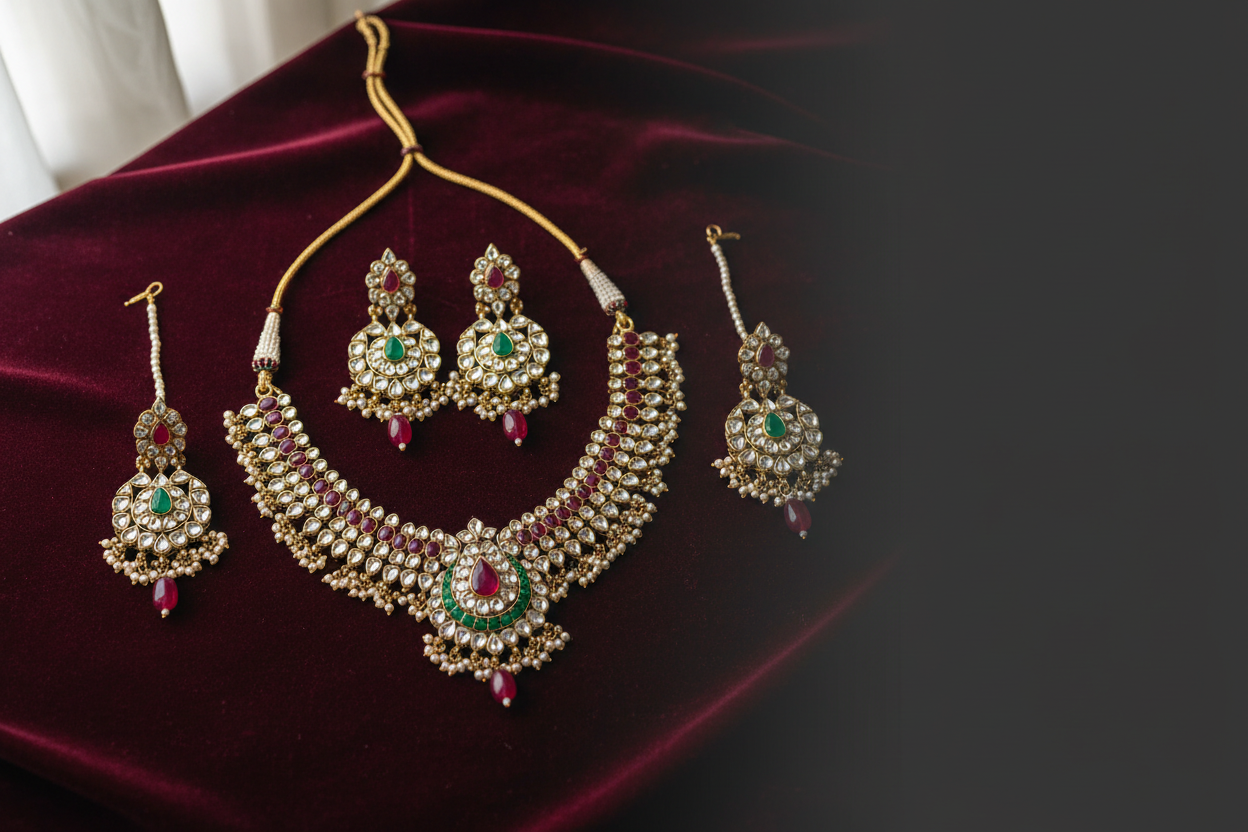
Kundan Jewellery: Origins, Craft and Styling Tips
Of all the jewellery traditions in India, Kundan is the one that has stayed closest to its roots.
More than two thousand years old. Still made largely by hand using the same fundamental technique refined in royal courts. Still chosen by Indian brides across every region. Still worn on the most important occasions of a woman's life.
And yet most people who wear Kundan jewellery have never been told what makes it what it is. Where it came from. What the word Kundan actually means. How a piece is made. What separates authentic Kundan craftsmanship from an imitation. How to wear it in ways that feel contemporary rather than ceremonial.
This guide covers all of it. The history, the craft process step by step, the regional variations, the difference between Kundan and Polki, and exactly how to wear Kundan jewellery today across every occasion type.
What Does the Word Kundan Actually Mean
The word Kundan comes from the Sanskrit root Kundana, meaning pure gold.
Kundan is a traditional form of Indian gemstone jewellery involving a gem set with a gold foil between the stones and its mount. The gold used in authentic Kundan work is not standard jewellery gold. It is gold refined to an exceptionally high purity, typically 24 karat, which makes it unusually soft and malleable. This softness is precisely what makes the Kundan setting technique possible.
The term kundan refers to highly refined or purified 24 karat gold. It refers specifically to gold that has been purified to an exceptionally soft state, allowing stones to be set without prongs.
That last detail is the key to understanding Kundan. The gold is so pure and so soft that it can be pressed around each stone to hold it in place without any mechanical fastening. No prongs. No claws. No solder. Just the gold itself, shaped by hand around each gem.
The History of Kundan Jewellery
Ancient Roots: The Royal Courts of Rajasthan
Origins of Kundan jewellery in India are dated back to at least the 3rd century BCE. Kundan started off in Rajasthan Royal court and then flourished under royal patronage during the Mughal era. The method is believed to have originated in the royal courts of Rajasthan and Gujarat.
In its earliest form, Kundan jewellery was exclusively the property of royalty. The gold required was expensive. The artisans capable of doing the work were rare. The time involved was significant. A single piece could represent months of one skilled craftsperson's labour. These realities confined Kundan to the courts of kings and queens.
The word Kundan is derived from the Sanskrit word Kundana, meaning pure gold. It is a Kundan jewellery making process in which a Kundansaz places uncut gemstones like diamonds, rubies, emeralds and sapphires into a pure gold foil framework to secure them without prongs or claws.
The artisan who performs this work is called a Kundansaz, and the title carries centuries of craft heritage. Today, families of Kundansazes in Jaipur and Bikaner continue to pass this skill from parent to child as they have for generations.
The Mughal Era: Kundan Reaches Its Peak
The Mughal era, spanning roughly the 16th to 18th centuries, is when Kundan jewellery reached its highest artistic development.
The art form flourished during the Mughal era. Mughal emperors introduced Persian design influences, bringing symmetry, gemstone carving, and refined detailing into Indian jewellery. This period gave rise to what is known as Mughal Kundan jewellery today.
The Persian influence changed Kundan in specific ways. Floral symmetry became central to Kundan design. Geometric precision became a marker of quality. The combination of stone setting on the front with Meenakari enamel on the reverse, which is still the defining feature of authentic Kundan pieces today, was refined during this period.
The Kundan jewellery technique is perhaps the oldest technique for setting stones in jewellery using gold in the Indian tradition. According to the book Traditional Indian Jewelry, this technique was first mentioned in the Ain-i-Akbari, the third and last book of Akbarnama, the official account of Akbar's rule.
This historical documentation matters. It means Kundan was significant enough to the Mughal court that it was recorded in their official state history.
Jaipur Becomes the Global Capital of Kundan
When royal artisans migrated to Rajasthan they brought their techniques and cultural influences with them. Jaipur soon became the preferred centre for Kundan work because of its royal patronage, artisan communities and access to gemstone markets. Over time the city refined Kundan craftsmanship into the world renowned style recognised today.
The city of Jaipur in Rajasthan has traditionally been the centre for Kundan in India. It remains an integral part of the traditional bridal wedding trousseau.
Jaipur's position as the Kundan capital is not accidental. It has three specific advantages that no other city has matched. Royal patronage that funded and encouraged the finest artisans for centuries. A gemstone trading market that gives Kundansazes access to stones from across India and beyond. And a concentration of artisan families who have specialised in different stages of the Kundan-making process for generations, creating a collaborative ecosystem that cannot easily be replicated elsewhere.
Explore authentic Kundan jewellery curated by Minerali: Browse the complete Kundan jewellery collection featuring designer pieces from India's finest labels at Minerali.
The Kundan Craft Process: Step by Step
Understanding how a Kundan piece is made changes how you see it and how you value it. Here is the complete process.
Step 1: The Ghat Framework
The process begins with creating the structural framework of the piece, called the Ghat. This is typically made in 22 karat gold and forms the overall shape, whether a necklace panel, a pendant, a bangle, or an earring.
The Ghat is not decorative. It is structural. It needs to be strong enough to hold the lac core and the stone settings in place across years of wearing. The quality of the Ghat work determines how well the finished piece holds together over time.
Step 2: Lac Filling
The inside of the gold framework is filled with lac, a natural resin derived from lac insects. The lac serves multiple purposes. It gives the piece weight and substance. It provides a cushioning base for the stone settings. And it stabilises the framework so that the pressure applied during stone setting does not distort the piece's shape.
Kundan jewellery is created by setting gemstones into layers of lac covered with ultra thin gold foil. The stones are placed into precise grooves and secured using pressure and foil instead of prongs. This technique creates a smooth reflective frame that enhances the brilliance of the stones.
Step 3: Stone Setting
This is the most skilled and most time-consuming part of the entire process.
The Kundansaz takes the highly refined 24 karat gold foil and begins pressing individual stones into the lac base. Each stone is placed, adjusted, and then the gold foil is pressed around its edges to hold it in position. The artisan works without prongs or mechanical aids. Only the pressure of their tools and their experience tells them whether each stone is secure.
The gold around each stone must be pressed evenly. The stone must sit flush and level with the surface. The edge of the gold must be smooth. Any inconsistency in stone placement or foil pressing is visible in the finished piece, which is why authentic Kundan stone setting reveals the skill of the individual artisan in every piece.
The craft behind Kundan jewellery is a meticulous process, often requiring skilled artisans and months of work. It begins with highly refined gold, which is used as the base. Gemstones and uncut diamonds are carefully set into place. Thin gold foil between the stones adds brilliance and depth.
Step 4: Meenakari on the Reverse
Once the front of the piece is completed, the reverse is finished with Meenakari enamel work.
This is a completely separate craft requiring completely different skills. The powdered enamel is applied to the gold surface of the reverse and fired at high temperature to fuse it permanently. Different colours require different firing temperatures. A complex Meenakari reverse may be fired multiple times.
The reverse of a Kundan piece being as considered as the front is one of the oldest marks of authentic Kundan craftsmanship. It reflects the philosophy that a piece worn close to the body deserves beauty on both sides.
Step 5: Finishing and Assembly
The final stage involves polishing, any additional surface work, and assembly of multi-piece necklaces or sets. Clasps and hooks are added. Each component is checked for stone security and finish quality.
A complete Kundan necklace set involving multiple panels, matching earrings, and a maang tikka can represent several weeks to several months of collective artisan work across multiple specialists.
Product Spotlight
The Kundan Blossom Glow Necklace Set at Minerali is a piece where every stage of the process described above is visible in the finished work.
Look at the stone placement across the floral motifs. Each stone sits flush and level. The gold between them is smooth and consistent. The layered structure of the necklace required multiple Ghat sections to be made and assembled in perfect proportion. The finishing across the entire set maintains the same quality standard from the largest central stone to the smallest accent piece.
This is what the Kundan-making process looks like when every stage has been executed without compromise.
Explore the Kundan Blossom Glow Necklace Set and look closely at the stone setting and gold foil work that defines authentic Kundan craftsmanship.
Regional Variations in Kundan Jewellery
Kundan is not one single aesthetic. Different regions of India have developed distinct styles of Kundan work that are recognisable to an experienced eye.
Rajasthan Kundan
Rajasthan is the birthplace of traditional Kundan jewellery designs, which are bold and royal. You can often notice rich colours and heavy stone settings. It stays closest to original Indian traditions. Minerali Store
Rajasthani Kundan tends toward larger stones, deeper colours, and heavier overall pieces. The Meenakari on Rajasthani Kundan is typically vivid and uses the traditional palette of red, green, and white. These are the pieces that carry the most direct visual connection to the royal court origins of the tradition.
Jaipur Kundan
Jaipur is globally known for its skilled artisans. Jaipur Kundan jewellery features fine craftsmanship and balanced proportions. The finishing is smooth and refined. The city remains the heart of Kundan artistry. Minerali Store
Jaipur's Kundan craftsmanship thrives within close knit artisan families where each generation inherits knowledge, techniques and cultural artistry. These communities have upheld Kundan traditions for centuries ensuring authenticity remains intact. VARNIYA
Jaipur Kundan is considered the benchmark of quality. The stone placement is typically more precise and more consistent. The proportions are more carefully balanced. The Meenakari on the reverse is often more intricate than in other regional styles. Jaipur Kundan commands a premium, and rightly so.
Delhi Kundan
Delhi designs blend traditional settings with modern aesthetics. The jewellery is usually lighter and more fashion-forward. It is perfect for contemporary bridal and partywear. The finishing is perfect for modern tastes while still preserving heritage. Minerali Store
Delhi Kundan represents the most contemporary interpretation of the tradition. The pieces are lighter. The stone choices sometimes include more unusual colours. The overall aesthetic is designed for buyers who want Kundan's heritage richness without the ceremonial heaviness of the traditional Rajasthani style.
Kundan vs Polki: The Difference Explained
This is the question most buyers have and most guides answer incompletely.
Both Kundan and Polki use the same fundamental setting technique. Gold foil pressed around stones without prongs. Both fall under the broader Jadau category of stone-setting techniques. The difference is specifically in the stone.
Kundan uses gemstones that can include glass, semi-precious stones, or precious stones set in the gold foil. The stones are typically more colourful, more varied, and available across a wider price range.
Polki uses exclusively natural, uncut diamonds left in their raw state without polishing or faceting. This is what gives Polki its distinctive softer, more earthy sparkle. Polki is generally more expensive than Kundan because the stones are genuine uncut diamonds.
Kundan jewellery uses gemstones supported by gold foil between the stones. Polki jewellery uses uncut diamonds set in gold, more raw and authentic. Both are forms of traditional jewellery and highly valued in wedding jewellery. Minerali Store
The simplest way to remember the difference: Kundan is about the colourful stone work and the gold foil setting. Polki is specifically the uncut diamond version of the same technique.
Explore both traditions at Minerali: Browse the Polki jewellery collection featuring natural uncut diamond pieces alongside the Kundan collection to see and compare both traditions side by side.
Product Spotlight
The Jadau Kundan Bangle at Minerali demonstrates one of the most traditional Kundan forms. The bangle is the oldest category of Kundan jewellery, worn in Indian courts for thousands of years before necklaces or earrings became the dominant Kundan pieces.
The stone setting across this bangle shows the precision that Jadau craftsmanship demands at the wrist scale. Each stone is individually set and individually positioned. The bangle's structural integrity across years of wear depends on the quality of each individual setting, which makes the Kundansaz's skill visible not just aesthetically but functionally.
See the Jadau Kundan Bangle and understand how the Jadau setting technique applies at the bangle scale with the same precision demanded of a full necklace set.
How to Identify Authentic Kundan Jewellery
Not all jewellery sold as Kundan is made using the genuine Kundan setting technique. Here is what to look for.
The stone edges. In authentic Kundan work, the gold edge around each stone should be smooth, even, and flush. There should be no visible adhesive, no rough edges, and no inconsistency in the way different stones sit in the same piece.
The reverse. A genuine Kundan piece has Meenakari enamel work or at minimum a finished gold surface on the reverse. A piece with an unfinished or rough reverse is not authentic Kundan.
The weight. Authentic Kundan pieces have a specific weight and substance that comes from the lac filling and the gold framework. Very light pieces claiming to be Kundan are typically imitation pieces in other metals.
The gold colour. The 24 karat gold used in authentic Kundan has a distinctive warm, almost orange-gold colour that is noticeably richer than 22 karat or 18 karat gold. The gold in an authentic piece looks visibly purer and more intense.
The stone seating. Each stone in an authentic piece should sit securely with no movement when gently pressed. A stone that moves even slightly has not been set correctly and will eventually fall out.
How to Style Kundan Jewellery Today
Kundan is the most versatile of India's heritage jewellery traditions because its visual weight can be calibrated from a single stud to a full bridal set. Here is how to wear it well across every occasion.
Kundan for Everyday and Office Wear
The idea of wearing Kundan to the office may seem like a stretch. It is not, if you choose the right piece.
A single Kundan stud or small Kundan hoop earring looks elegant and intentional with a kurta, a blouse, or even a blazer. It adds a touch of traditional craft to an everyday outfit without making the look ceremonial.
A thin Kundan bangle worn alone on one wrist is equally effective. One piece of Kundan with an otherwise minimal look is a strong everyday styling choice.
What to avoid for everyday wear: full Kundan sets, layered necklaces, and anything that requires your full attention to wear comfortably throughout an eight-hour day.
Browse Kundan pieces suited for daily and office wear: Explore earrings from the Kundan collection at Minerali for everyday-appropriate Kundan styling options.
Kundan for Festive Occasions
Festive wear is where Kundan's full range comes into play.
A Kundan choker with a matching pair of jhumkas or chandbalis is the most complete and most relevant festive Kundan look right now. The choker sits at the collarbone and photographs beautifully. The earrings frame the face.
Add one Kundan bangle or a small bangle stack to complete the wrist. A maang tikka if the occasion and outfit support it.
This combination, necklace, earrings, and one wrist piece, is the sweet spot for festive occasions. It is fully dressed without being bridal.
Kundan for Weddings as a Guest
As a wedding guest, a Kundan necklace set with matching earrings and a small bangle stack hits the right level. Bold enough to mark the occasion. Restrained enough to support rather than compete with the bride.
Choose your Kundan pieces in gold tones with coloured stone accents that work with your outfit colour. A deep red or emerald green stone Kundan set against a deep navy or ivory outfit is a consistently strong guest styling choice.
Kundan as Bridal Jewellery
For bridal wear, Kundan is the anchor tradition. The full bridal Kundan look, layered necklace set, matching jhumkas or chandbalis, bangles, haath phool, and maang tikka, is the most complete expression of Indian bridal jewellery heritage.
The key for 2026 brides is to choose Kundan pieces that are lightweight and open in setting rather than very heavy traditional forms. Modern Polki and Kundan jewellery designs focus on open, airy settings instead of the older heavy look, making them more wearable while retaining their traditional appeal. Jewelove™
Shop the complete bridal Kundan range at Minerali: Explore the Bridalaya bridal collection at Minerali for curated Kundan bridal sets designed for modern Indian brides.
Kundan With Western Outfits
One Kundan piece with a clean western outfit is one of the strongest Indo-fusion styling moves available to Indian women.
A Kundan choker with a deep V-neck black dress. A pair of Kundan chandbalis with a white shirt and trousers. A Kundan ear cuff with a structured blazer and wide-leg trousers. In each case, the Kundan piece is the single traditional element and the outfit provides a clean, modern background.
The rule: one Kundan piece, not a full set. The contrast between the Indian craft and the western silhouette is the point. Multiple Kundan pieces with western clothes tips from contrast into costume.
Product Spotlight
The Kundan Meera Shringar Hathphool at Minerali is a piece that represents Kundan jewellery at its most complete and most culturally significant.
The Meera Shringar design draws on classical Indian motifs rendered in Kundan stone work across both the wrist bracelet and the ring, connected by delicate chains across the hand. The piece is simultaneously a technical achievement, requiring precise setting across multiple surfaces and structural components, and a cultural statement connecting the wearer to centuries of Indian jewellery tradition.
Worn with a lehenga or a heavy saree at a wedding or festive occasion, this haath phool transforms the entire look of the hand and wrist in a way that no other single piece achieves.
View the Kundan Meera Shringar Hathphool and see how Kundan craftsmanship applied across the full surface of the hand creates one of Indian jewellery's most distinctive and most photographed bridal pieces.
Caring for Your Kundan Jewellery
Kundan pieces require specific care because of their construction. The lac base, gold foil setting, and Meenakari reverse all respond badly to moisture, chemicals, and rough handling.
Never soak Kundan in water. Never use liquid cleaners. Never spray perfume while wearing it. Store each piece individually in soft cloth to prevent stone surfaces from scratching each other.
Clean only with a soft dry cloth, wiped gently across the surface. For dust in the stone settings, a soft dry brush applied very gently.
Check stone security periodically. Press each visible stone lightly. Any movement means the setting needs professional attention before you wear the piece again.
Stored and cared for correctly, a well-made Kundan piece will last for decades and can genuinely be passed down as an heirloom.
Frequently Asked Questions
What is the origin of Kundan jewellery?
Kundan jewellery originated in the royal courts of Rajasthan and Gujarat, with evidence of the technique dating back to at least the 3rd century BCE. The craft reached its artistic peak during the Mughal era, when Persian design influences including symmetry, floral motifs, and detailed enamel work were combined with Indian goldsmithing traditions. Jaipur became and remains the global centre of Kundan craftsmanship.
What is the difference between Kundan and Polki jewellery?
Both Kundan and Polki use the Jadau setting technique, where gold foil is pressed around stones without prongs. The difference is the stone. Kundan uses coloured gemstones or glass. Polki uses exclusively natural uncut diamonds left in their raw state. Polki is generally more expensive because of the genuine uncut diamond content.
How is Kundan jewellery made?
Kundan jewellery is made in five stages. A gold framework called the Ghat is created. The inside is filled with lac resin for stability. Individual stones are set by hand using 24 karat gold foil pressed around each gem. The reverse is finished with Meenakari enamel work. The piece is then polished and assembled. The stone setting stage alone can represent weeks of work on a complex necklace.
How do I know if my Kundan jewellery is authentic?
Check the stone edges for smooth, consistent gold foil. Check the reverse for Meenakari enamel or a finished gold surface. Check the weight for the substance of a lac-filled piece. Check each stone for security by pressing gently. Authentic Kundan has a warmth and richness to the gold colour that is noticeably different from gold-plated imitations.
Can Kundan jewellery be worn with western outfits?
Yes. One Kundan piece worn with a clean western outfit is one of the strongest Indo-fusion styling choices available. A Kundan choker with a black dress, chandbali earrings with a white shirt and trousers, or a Kundan ear cuff with a structured blazer all work beautifully. The rule is one Kundan piece, not a full set, so the contrast between Indian craft and western silhouette remains the deliberate point.
How should I care for Kundan jewellery?
Store each piece individually in soft cloth. Never soak in water or any liquid. Never use chemical cleaners. Never spray perfume while wearing. Clean only with a dry soft cloth. Check stone settings periodically for any movement. With correct care, Kundan jewellery lasts for decades and can be passed down as a family heirloom.
Final Thoughts
Kundan jewellery is not just a style. It is a living tradition that connects the woman wearing it to more than two thousand years of Indian craft history.
Every piece carries the fingerprints of the Kundansaz who set each stone. Every floral motif echoes the design vocabulary of Mughal courts. Every flash of colour in the stones and every vivid line in the Meenakari reverse is the result of skills refined across generations.
When you choose Kundan, you are choosing more than a beautiful piece of jewellery. You are choosing to carry a piece of that tradition with you.
Minerali carries Kundan jewellery from some of India's finest designer labels, curated for craft quality, design integrity, and genuine heritage in every piece.

Written by Chirag Jain

Hair Accessory Features: Choosing Between Maang Tikka, Matha...
Jul 24, 2026

From Sketchbook to Showcase: How Designer Jewellery Comes...
Jul 20, 2026

Jewellery Buying Tips: 15 Questions to Ask Before...
Jul 18, 2026

The Symbolism Behind Traditional Indian Jewellery Motifs and...
Jul 14, 2026

Wedding Jewellery Guide: How to Rewear Bridal Jewellery...
Jul 10, 2026

How to Style Jewellery for Different Necklines in...
Jul 06, 2026

Why Minimalist Jewellery Is Becoming Every Indian Woman's...
Jul 02, 2026

Complete Jewellery Gifting and Care Guide for Buyers
Jun 28, 2026

Hair Accessories and Jewellery Pieces You Will Love
Jun 25, 2026

Meet the Faces Behind Minerali's Designer Community
Jun 19, 2026

