
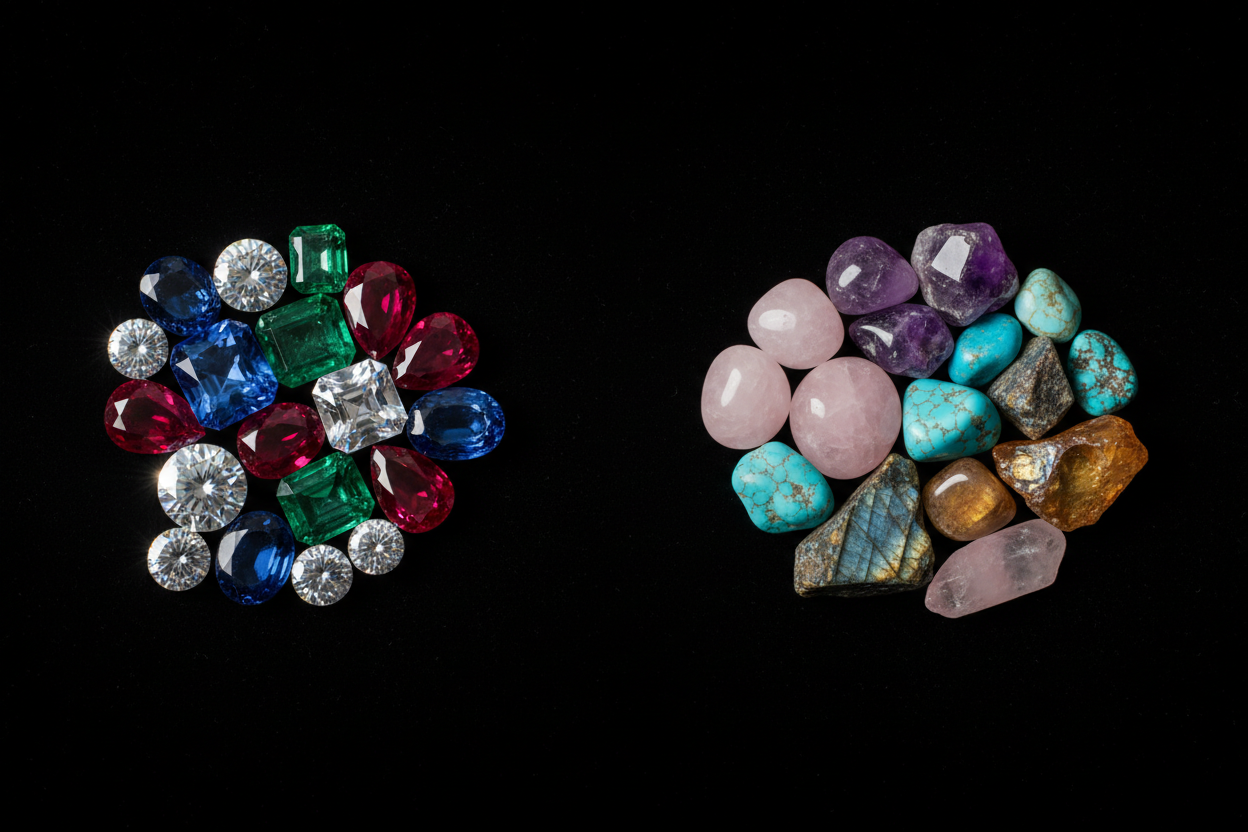
Precious vs Semi-Precious Stones: What's Right for You
Most people have bought jewellery with a coloured stone without fully understanding what makes that stone what it is.
Is it a precious stone or a semi-precious one? Does that actually matter? Does the category tell you anything useful about how much the stone is worth, how hard it is, or how it will look in five years?
These are the questions this guide answers.
Understanding the difference between precious and semi-precious stones is genuinely useful when you are choosing jewellery. It helps you make smarter decisions, ask better questions, and buy with more confidence.
What Are Precious Stones
Traditionally, only four stones are classified as precious. Diamond, ruby, sapphire, and emerald.
This classification dates back centuries and was originally based on rarity, hardness, and the cultural significance of each stone. These four stones appeared in the jewellery of royalty and the wealthiest merchants across the world for thousands of years. Their historical association with power and wealth is part of what made the classification stick.
Here is a brief portrait of each.
Diamond
Diamond is the hardest natural material on earth. It ranks 10 on the Mohs hardness scale, which is the standard measure of a gemstone's resistance to scratching. This hardness means a diamond will not scratch, chip, or dull under normal wearing conditions.
Diamonds come in white, near-colourless, and in rare fancy colours including yellow, pink, blue, and green. White and near-colourless diamonds are the most common in jewellery. The value of a diamond is determined by four factors: cut, colour, clarity, and carat weight.
In Indian jewellery, diamonds appear most strikingly in Polki work, where uncut natural diamonds are used in their raw state without polishing or faceting. This is a distinctly Indian tradition and produces a very different visual quality from polished diamond jewellery.
Ruby
Ruby is the red variety of the mineral corundum. The most prized rubies have a deep, vivid red with a slight hint of blue. The finest rubies come from Myanmar, Sri Lanka, and Mozambique.
Rubies rank 9 on the Mohs hardness scale, which makes them extremely durable and suitable for daily wear. In Indian jewellery, deep red stones have cultural significance across multiple traditions and appear frequently in bridal and festive pieces.
Sapphire
Sapphire is the blue variety of corundum, the same mineral family as ruby. But sapphires are not limited to blue. They come in almost every colour except red, which becomes a ruby. Pink, yellow, orange, and even colourless sapphires exist.
Like rubies, sapphires rank 9 on the Mohs hardness scale. The most prized sapphires are a deep, vivid blue from Kashmir, Sri Lanka, or Myanmar.
Emerald
Emerald is the green variety of the mineral beryl. The most valuable emeralds come from Colombia, Zambia, and Brazil. Emeralds rank 7.5 to 8 on the Mohs scale, which makes them slightly more vulnerable to scratching than diamonds, rubies, and sapphires.
In Indian jewellery, emeralds have appeared in royal pieces for centuries. The deep green of a fine emerald against gold or Polki diamonds is one of the most powerful colour combinations in Indian jewellery tradition.
Explore pieces featuring precious stone work: Browse the diamond jewellery collection and Polki collection using natural uncut diamonds at Minerali for pieces that feature precious stone traditions.
What Are Semi-Precious Stones
Every gemstone that is not a diamond, ruby, sapphire, or emerald is technically classified as semi-precious.
This is a large and extraordinarily diverse category. It includes hundreds of different stones across a huge range of colours, hardness levels, and price points. Some semi-precious stones, like tanzanite and fine alexandrite, are rarer and more expensive than lower-quality precious stones. The category name is genuinely misleading.
Here are the semi-precious stones that appear most frequently in Indian designer jewellery.
Pearl
Pearl is one of the most beloved stones in Indian jewellery and technically one of the most unusual. It is not a mineral. It is an organic material produced by mollusks. Natural pearls are extraordinarily rare. Most pearls available today are cultured, which means the process that produces the pearl is stimulated rather than occurring spontaneously.
Pearls rank only 2.5 to 4.5 on the Mohs scale, which means they are among the softer materials used in jewellery. They scratch relatively easily and are damaged by acidic substances including perfume and sweat. But their lustre, their warmth, and their cultural depth in Indian jewellery make them irreplaceable.
Turquoise
Turquoise is one of the oldest gemstones used in Indian jewellery, particularly in the tribal and folk traditions of Rajasthan and Gujarat. It ranges from sky blue to blue-green and is typically opaque rather than transparent.
Turquoise ranks 5 to 6 on the Mohs scale and requires careful handling. It is sensitive to heat, chemicals, and prolonged exposure to sunlight, which can fade its colour.
Garnet
Garnets are a family of minerals rather than a single stone. They come in deep red, which is the most familiar, but also in orange, yellow, green, and occasionally blue. Most garnets rank 6.5 to 7.5 on the Mohs scale.
In Indian jewellery, deep red garnets are sometimes used in settings where rubies would be traditional but cost prohibitive. A quality garnet has genuine richness of colour that is visually compelling.
Amethyst
Amethyst is the purple variety of quartz and one of the most widely used semi-precious stones globally. It ranks 7 on the Mohs scale. In Indian contemporary jewellery, amethyst appears frequently in silver settings and contemporary designs aimed at everyday wear.
Aquamarine
Aquamarine is the pale blue variety of the mineral beryl, the same family as emerald. The name means seawater in Latin and the colour ranges from pale icy blue to a deeper blue-green. It ranks 7.5 to 8 on the Mohs scale and is relatively durable.
Aquamarine has become increasingly popular in contemporary Indian jewellery for its clean, modern colour that pairs beautifully with silver and contemporary gold-finish settings.
Product Spotlight
The Multi Gemstone Gold Electroplated Necklace at Minerali is one of the clearest examples of how semi-precious stones can be used together to create a piece of genuine visual richness.
Multiple stone types in one piece allow the designer to create colour conversations across the necklace. Each stone carries its own character. Together they produce a layered visual effect that no single-stone piece can match. The gold electroplating provides a setting that enhances each stone colour.
Explore the Multi Gemstone Gold Electroplated Necklace and see how multiple semi-precious stones work together in a contemporary designer setting.
The Hardness Scale: Why It Actually Matters for Jewellery
The Mohs hardness scale is the most useful tool for understanding whether a stone is appropriate for the type of jewellery you want and the way you intend to wear it.
The scale runs from 1 to 10. The higher the number, the harder the stone and the more resistant it is to scratching.
Diamonds: 10. The hardest natural material. Cannot be scratched by any other natural material.
Rubies and sapphires: 9. Extremely durable. Suitable for daily wear in any type of setting.
Emeralds: 7.5 to 8. Durable but more vulnerable than rubies and sapphires. Requires slightly more care.
Aquamarine, amethyst, garnet: 7 to 7.5. Suitable for occasional wear jewellery and festive pieces. Less suitable for daily-wear rings where the stone surface is most exposed.
Pearls and turquoise: 2.5 to 6. Soft and easily scratched. Best in settings that protect the stone from contact with other surfaces. Not suitable for ring stones in most cases.
The practical takeaway: if you are buying a ring you intend to wear every day, choose a stone that ranks 8 or above. If you are buying earrings or a necklace for festive or occasional wear, hardness is much less critical because these settings expose the stone to far less abrasion.
The Colour Question: How Stones Work With Indian Skin Tones and Outfits
Stone colour is where most buying decisions in Indian jewellery are actually made. And there are some genuinely useful principles.
Gold settings warm up cooler-coloured stones. A blue sapphire or a pale aquamarine in a gold setting looks richer and more saturated than the same stone in silver.
Silver settings cool down warmer-coloured stones. A deep red garnet or a vivid orange carnelian in silver looks crisper and more contemporary.
For warm to medium Indian skin tones, gold settings with warm stone colours, deep red, orange, green, and rich yellow, tend to be most flattering. These combinations are the foundation of most traditional Indian festive jewellery for a reason.
For cooler-toned skin, silver with blue, purple, and pale green stones creates a clean, elegant contrast.
For evening and party wear, coloured stone contrast matters more than coordination. A vivid green stone against a black dress, or a deep red stone against ivory, creates visual impact that a matching stone colour never achieves.
Product Spotlight
The Green Stone Drop Necklace Set demonstrates exactly how a semi-precious coloured stone in a well-designed gold-finish setting creates a piece with precious stone visual richness.
The green stones in this set have a depth that photographs beautifully under all lighting conditions. The drop structure adds movement. The gold-finish setting warms the stone colour and creates a visual relationship between the stone and the metal that feels expensive and considered.
This is the piece that makes people ask where you got your jewellery.
Discover the Green Stone Drop Necklace Set and see how a well-chosen semi-precious stone outperforms expectations.
Precious vs Semi-Precious: The Honest Answer
Here is the truth that the jewellery industry does not always tell you clearly.
The precious and semi-precious classification is a historical commercial distinction, not a scientific one. There is no internationally agreed scientific definition of what makes a stone precious. The traditional Big Four classification was based on historical rarity and cultural status, both of which have changed significantly since the categories were created.
Today, the most expensive stones in the world on a per-carat basis include several that are technically classified as semi-precious. Fine alexandrite, certain tanzanites, and Kashmir sapphires of exceptional quality have sold for prices that exceed many precious stone varieties of lower quality.
What actually determines the value of any stone is rarity, colour quality, clarity, size, and the craftsmanship of the setting. A low-quality diamond is worth less than a high-quality amethyst in the right design.
This means that choosing between precious and semi-precious stones should not be a category decision. It should be a quality and context decision. Choose the stone whose colour speaks to you, whose quality is verifiable, and whose hardness is appropriate for how you intend to wear it.
Frequently Asked Questions
What are the four precious gemstones in jewellery?
The four traditionally classified precious gemstones are diamond, ruby, sapphire, and emerald. All other gemstones are technically classified as semi-precious. This classification is historical and commercial rather than scientific, and does not reflect the actual value hierarchy of all gemstones in today's market.
Are semi-precious stones less valuable than precious stones?
Not necessarily. Some semi-precious stones, including fine tanzanite, alexandrite, and exceptional quality aquamarine, can be more expensive per carat than lower-quality precious stones. The true value of any stone depends on its rarity, colour quality, clarity, and size, not its classification category.
What is the most durable stone for everyday jewellery wear?
Diamond is the most durable stone with a Mohs hardness of 10. Rubies and sapphires at 9 are also excellent for daily wear. For festive or occasional wear jewellery like earrings and necklaces, most stones including semi-precious options are suitable since these settings protect the stone from surface abrasion.
What semi-precious stones are most popular in Indian jewellery?
Pearls, turquoise, garnet, amethyst, and aquamarine are among the most commonly used semi-precious stones in Indian designer jewellery. Green stones broadly, including emerald-inspired tones, are particularly popular right now across both traditional and contemporary Indian jewellery design.
What stone colour works best with a gold-finish setting?
Warm-toned stones including deep red, orange, green, and rich yellow look most striking in gold settings. The gold warming effect enhances these colours and gives the piece a richness associated with traditional Indian jewellery. Cool-toned stones in blue and purple also work well in gold settings where the contrast between the metal warmth and the stone coolness creates visual interest.
Should I choose precious or semi-precious stones for bridal jewellery?
Most traditional Indian bridal jewellery, including Kundan and Polki work, uses semi-precious or uncut stones in gold foil settings rather than cut precious stones. The visual richness of a full Kundan bridal set comes from the density and colour of the stone work, not from the classification of the stones used. Choose stones whose colour works with your outfit and whose setting style reflects your aesthetic.
Quick Stone Selection Guide
For daily wear rings: Diamond, ruby, or sapphire at 9 to 10 on Mohs. These handle daily contact without scratching.
For festive earrings and necklaces: Almost any stone works. Pearls, garnets, amethysts, turquoise, and emeralds are all appropriate since earrings and necklaces have less surface abrasion exposure.
For maximum colour impact: Deep red rubies or garnets, vivid green emeralds or jade-toned stones, and rich blue sapphires or lapis create the most striking single-colour visual effects.
For contemporary everyday wear: Aquamarine, amethyst, and pearl in silver settings are clean, modern, and appropriate for both western and Indian everyday dressing.
For bridal and festive traditional wear: Navratan combinations featuring all nine auspicious stones, Kundan work with coloured glass or semi-precious stones, and Polki with uncut diamonds are the traditional choices.
Final Thoughts
The distinction between precious and semi-precious stones is useful as a starting point. It tells you something about general rarity and price range. But it does not tell you which stone is right for you.
Right for you means the colour that speaks to you, the hardness that suits how you intend to wear it, and the setting that brings the best out of the stone. A beautifully chosen semi-precious stone in a well-crafted setting will always outperform a mediocre precious stone set carelessly.
Minerali carries jewellery across Kundan, Polki, diamond, and contemporary collections that feature a wide range of stone types, both precious and semi-precious, set by designers with genuine craft behind their work.

Jewellery Gifting Guide: How to Choose the Perfect...
Jul 29, 2026

Hair Accessory Features: Choosing Between Maang Tikka, Matha...
Jul 24, 2026

From Sketchbook to Showcase: How Designer Jewellery Comes...
Jul 20, 2026

Jewellery Buying Tips: 15 Questions to Ask Before...
Jul 18, 2026

The Symbolism Behind Traditional Indian Jewellery Motifs and...
Jul 14, 2026

Wedding Jewellery Guide: How to Rewear Bridal Jewellery...
Jul 10, 2026

How to Style Jewellery for Different Necklines in...
Jul 06, 2026

Why Minimalist Jewellery Is Becoming Every Indian Woman's...
Jul 02, 2026

Complete Jewellery Gifting and Care Guide for Buyers
Jun 28, 2026

Hair Accessories and Jewellery Pieces You Will Love
Jun 25, 2026

