
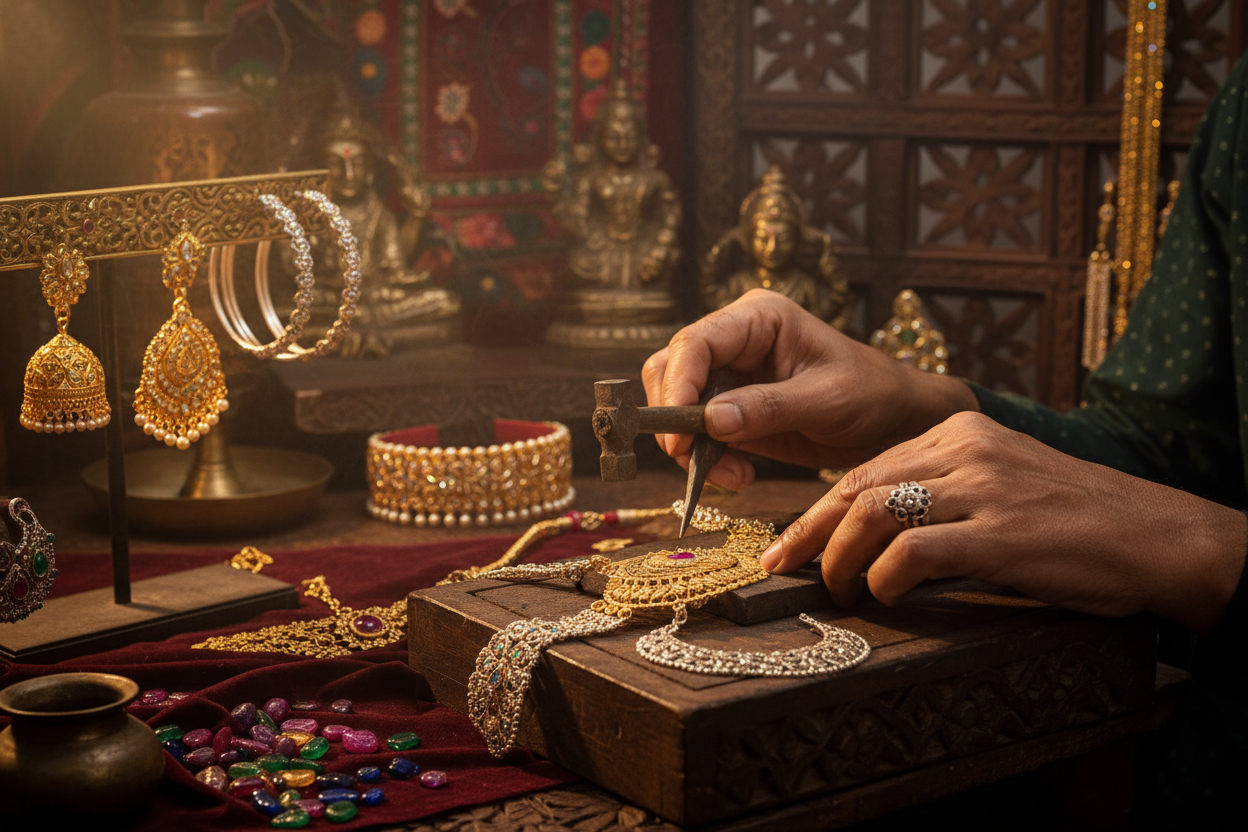
The Art of Handcrafted Jewellery in India
Every piece of handcrafted jewellery begins with a person sitting down with metal, stone, and decades of inherited knowledge.
Not a machine. Not a mould. A person.
India has one of the richest and most diverse jewellery-making traditions in the world. Techniques that took centuries to develop are still practised today in the workshops of Jaipur, Hyderabad, Lucknow, and Odisha. Skills that were refined in Mughal courts are still being passed from master to apprentice in small family workshops across Rajasthan.
When you buy a handcrafted piece, you are not just buying jewellery. You are buying the result of a skill that someone spent their entire life learning. And in many cases, a skill their parents and grandparents spent their lives learning before them.
This guide covers what handcrafted jewellery in India actually means, the specific techniques behind the most important styles, what separates a handcrafted piece from a machine-made one, and why it matters for the jewellery you choose to wear.
What Does Handcrafted Actually Mean in Indian Jewellery
The word handcrafted is used loosely in the jewellery industry. It is worth understanding what it actually means before you spend money on something described that way.
True handcrafted jewellery is made without the use of mechanical mass-production processes. The artisan shapes the metal, sets the stones, applies the enamel, and polishes the surface by hand. Each piece is made individually. No two pieces are exactly alike even if they are made from the same design.
Machine-made jewellery starts with a mould or a stamping process. Identical pieces are produced at volume. The finish is uniform. The weight and dimensions are consistent across every unit. It is efficient and it is often visually attractive. But it carries none of the human presence of a handcrafted piece.
The difference is not always visible to the eye. But it is visible in the way the piece wears over time, in the subtle variations in stone placement, in the slight irregularity of a hand-hammered surface. These are not flaws. They are the marks of a person's hand. They are what make the piece singular.
The Major Handcrafted Jewellery Techniques in India
Kundan Setting: The Oldest Stone Setting Tradition in Indian Jewellery
Kundan is one of the most ancient and technically demanding jewellery-making techniques in India. It originated in the royal courts of Rajasthan and was refined to its highest level during the Mughal era.
The technique works like this. A base of pure gold foil is shaped into the form of the piece. The artisan then softens the gold and presses each stone individually into position. No prongs. No glue. No mechanical settings. The stone is held by the gold itself, which is moulded around it until the setting is secure.
This process requires exceptional skill. Setting a single stone can take many hours. A full Kundan necklace can represent weeks of work by one artisan. The result is a seamless, flat-surfaced setting where the stone appears to float in gold, with no visible holding mechanism.
The reverse side of most Kundan pieces is then finished with Meenakari enamel, a completely separate craft in its own right. This means the artisan who makes a Kundan piece has typically spent years mastering two distinct techniques.
Explore Kundan craftsmanship on Minerali: Browse the handcrafted Kundan jewellery collection to see pieces made using this centuries-old setting tradition.
Product Spotlight
The Kundan Blossom Glow Necklace Set is a clear example of what Kundan craftsmanship looks like at its best.
The floral motifs require each petal to be individually formed and set. The stones across the necklace are placed by hand. The layered structure means multiple sections of stone setting work, each one completed separately before the piece is assembled. This is not a quick piece to make. The time it takes is visible in every detail.
Explore the Kundan Blossom Glow Necklace Set and look closely at the stone placement detail that only handcrafting produces.
Jadau: The Art of Embedding Stones Without Soldering
Jadau is the broader technique that encompasses both Kundan and Polki work. The word refers specifically to the process of embedding stones into a gold base without soldering or any mechanical fastening.
The Jadau technique was introduced to India by the Mughals and perfected by the artisans of Rajasthan, particularly in Bikaner and Jaipur. It remains one of the most labour-intensive jewellery-making processes in the world.
Setting a single stone in Jadau can genuinely take from sunrise to sunset. The artisan works the gold into the precise shape needed to hold each stone, tests the fit, adjusts, and tests again. This process is repeated for every stone in the piece. A complex Jadau necklace can represent months of one artisan's work.
The Jadau tradition is also deeply community-based. Different artisans often specialise in different stages of the process. One artisan might be responsible only for the gold-forming stage. Another only for stone setting. A third for finishing and polishing. The piece passes through several pairs of skilled hands before it is complete.
See Jadau craftsmanship in practice: Browse the Jadau Kundan Bangle at Minerali as a detailed example of what this technique produces.
Meenakari: The Enamel Art of Jaipur
Meenakari is the art of fusing coloured enamel onto metal surfaces at high temperature. It is a craft with Persian origins that was brought to India in the 16th century and transformed by Rajasthani artisans into something entirely its own.
The Meenakari process requires precise temperature control. The powdered enamel is applied to the metal surface and then fired in a kiln. Different colours require different temperatures. A single piece may be fired multiple times to achieve layered colour effects. The artisan must judge by eye whether the firing is correct. Too little heat and the enamel does not fuse properly. Too much and the colour burns.
The most traditional Meenakari work uses red, green, and white, which are considered the colours of gold. Contemporary Meenakari incorporates a wider palette including soft pinks, blues, and pastels that have become particularly popular for festive occasion jewellery.
Jaipur remains the global centre of Meenakari craft. Families that have practised this art for generations continue to maintain workshops there today.
Explore pieces featuring Meenakari enamel work: Browse the festive and bridal jewellery available on Minerali for pieces that incorporate Meenakari detailing alongside Kundan stone setting.
Product Spotlight
The Festive Meenakari Choker Necklace is one of the clearest examples of Meenakari craftsmanship currently available on Minerali.
The vivid enamel colour work visible on this choker is the result of multiple firings, each one building the colour depth and surface quality of the enamel. The artisan who made this piece has spent years learning to control the temperature and application precision that produces this quality of enamel finish. The skill is embedded in the surface of the piece.
See the Festive Meenakari Choker Necklace and look at the enamel surface detail that only a skilled craftsperson can produce.
Tarakashi: Silver Filigree From Odisha
Tarakashi is one of the most delicate and technically demanding handcrafted jewellery techniques in India. It originates from Cuttack in Odisha and has been awarded Geographical Indication status, which means it is officially recognised as a product of that specific place.
The technique involves drawing fine silver wire to an extraordinary thinness and then weaving it into intricate patterns by hand. The result looks almost like lacework made of metal. There are no moulds involved. The patterns are constructed entirely by the artisan's hands and tools, following designs that have been refined across generations.
A single Tarakashi earring can involve hundreds of individual wire segments, each one placed and fixed by hand. The total wire length in a complex Tarakashi piece can run to several metres despite the finished piece fitting in your palm.
The skill required to produce high-quality Tarakashi is rare even within Odisha. It takes many years of practice before an artisan can work at the level required to produce pieces of genuine quality.
Browse silver jewellery with craft heritage: Explore 925 silver jewellery from Gemstruck and handcrafted silver pieces by Sangeeta Boochra at Minerali for silver jewellery that carries the weight of Indian craft tradition.
Dhokra: Lost-Wax Casting From Tribal India
Dhokra is one of the oldest metal casting techniques in the world, and it is still practised today by tribal artisan communities in Jharkhand, Chhattisgarh, West Bengal, and Odisha.
The process uses the lost-wax method. The artisan creates a wax model of the piece by hand, wraps it in clay, and then melts the wax out of the clay mould. Metal is then poured into the mould. When the clay is broken away, the metal has taken the shape of the original wax model.
Because each wax model is made by hand and destroyed in the process, no two Dhokra pieces are ever identical. Every piece is genuinely singular in a way that no other jewellery-making technique produces.
Dhokra pieces have a distinctive raw, earthy texture and warmth that comes directly from the handmade wax model. This texture is not a flaw. It is the fingerprint of the human who made the original form.
Why Handcrafted Jewellery Is Worth More Than Machine-Made
This is a question worth answering directly.
Handcrafted jewellery costs more because it takes longer, requires more skill, and produces pieces that cannot be replicated at volume. A Kundan necklace that takes three weeks to make by one skilled artisan will always cost more than a machine-stamped necklace of similar visual appearance. That cost difference is the labour of a human being who spent years developing their skill.
There is also a quality argument. Handcrafted stone settings are individually adjusted for each stone. Machine settings are uniform and may not account for the natural variation in stone size and shape. Over time, a well-made handcrafted setting holds stones more securely than a mass-produced one because the setting was made for that specific stone.
And there is a value argument. Handcrafted pieces from skilled artisans hold their value and often appreciate. They are the pieces passed down from mother to daughter. Machine-made jewellery at the same price point is rarely considered an heirloom.
How to Identify Genuinely Handcrafted Jewellery
You do not need to be an expert to identify a handcrafted piece from a machine-made one. Look for these signs.
Slight variation in stone placement. If every stone sits at a perfectly identical angle in every piece of the same design, the setting was almost certainly done mechanically. Handcrafted settings show tiny variations that are not visible enough to be called errors but are present if you look closely.
Surface texture. A hand-hammered or hand-finished metal surface has a quality that is different from a machine-polished surface. It catches light differently. It has micro-variations in depth that machine polishing removes.
Weight distribution. Handcrafted pieces often feel slightly different in weight distribution compared to machine-made pieces because the metal is formed by hand rather than pressed into a uniform mould.
The artisan's mark. Genuine designer handcrafted pieces often carry the designer's hallmark or signature. Every piece sold through Minerali comes from a named designer label with verifiable craftsmanship standards.
Frequently Asked Questions
What makes Indian handcrafted jewellery different from regular jewellery?
Indian handcrafted jewellery is made by skilled artisans using techniques that in many cases have been practised for centuries. Each piece is made individually by hand. No two pieces are exactly alike. The techniques, including Kundan setting, Jadau embedding, Meenakari enamelling, and Tarakashi filigree, require years of training to master and cannot be replicated by machines at the same quality level.
How long does it take to make a handcrafted Kundan necklace?
Depending on the complexity, a full Kundan necklace set can take anywhere from several days to several weeks of work by one or more skilled artisans. A complex Jadau piece with hundreds of individually set stones can take months. This time investment is reflected in the quality and longevity of the finished piece.
What is the difference between Kundan and Jadau jewellery?
Jadau is the broader technique of embedding stones into gold without soldering, developed during the Mughal era. Kundan is a specific form of Jadau that uses semi-precious or glass stones set in pure gold foil. All Kundan jewellery uses the Jadau technique, but not all Jadau pieces are Kundan. Polki jewellery, which uses uncut diamonds, also uses the Jadau setting technique.
Is handcrafted jewellery more durable than machine-made jewellery?
In most cases, yes. A handcrafted stone setting is made for the specific stone it holds. The artisan adjusts the setting to the stone's exact shape and size. Machine settings are uniform and may not grip irregular stones as securely. Additionally, handcrafted pieces are typically made from higher-quality base materials because the artisan's time investment demands a worthy material.
Where in India is the best handcrafted jewellery made?
Different regions specialise in different techniques. Jaipur and Bikaner in Rajasthan are the global centres for Kundan, Polki, Jadau, and Meenakari work. Cuttack in Odisha is the home of Tarakashi silver filigree. Hyderabad is known for its Lac jewellery and pearl work. Bengal is associated with gold repoussé work and filigree chandbalis. Tribal communities across Jharkhand, Chhattisgarh, and West Bengal practise Dhokra casting.
Final Thoughts
Every handcrafted jewellery piece is the result of someone choosing skill over speed. Tradition over convenience. Craft over volume.
When you wear a handcrafted piece, you are wearing the work of a person who dedicated years to learning a skill that not many people in the world possess. That is what sits on your wrist or your neck or your ears. That is what you are buying when you choose handcrafted over machine-made.
Minerali curates handcrafted designer jewellery from some of India's finest labels. Every piece on the platform has gone through a curation process that demands quality, craft, and genuine design identity.

Written by Chirag Jain

Jewellery Gifting Guide: How to Choose the Perfect...
Jul 29, 2026

Hair Accessory Features: Choosing Between Maang Tikka, Matha...
Jul 24, 2026

From Sketchbook to Showcase: How Designer Jewellery Comes...
Jul 20, 2026

Jewellery Buying Tips: 15 Questions to Ask Before...
Jul 18, 2026

The Symbolism Behind Traditional Indian Jewellery Motifs and...
Jul 14, 2026

Wedding Jewellery Guide: How to Rewear Bridal Jewellery...
Jul 10, 2026

How to Style Jewellery for Different Necklines in...
Jul 06, 2026

Why Minimalist Jewellery Is Becoming Every Indian Woman's...
Jul 02, 2026

Complete Jewellery Gifting and Care Guide for Buyers
Jun 28, 2026

Hair Accessories and Jewellery Pieces You Will Love
Jun 25, 2026

